

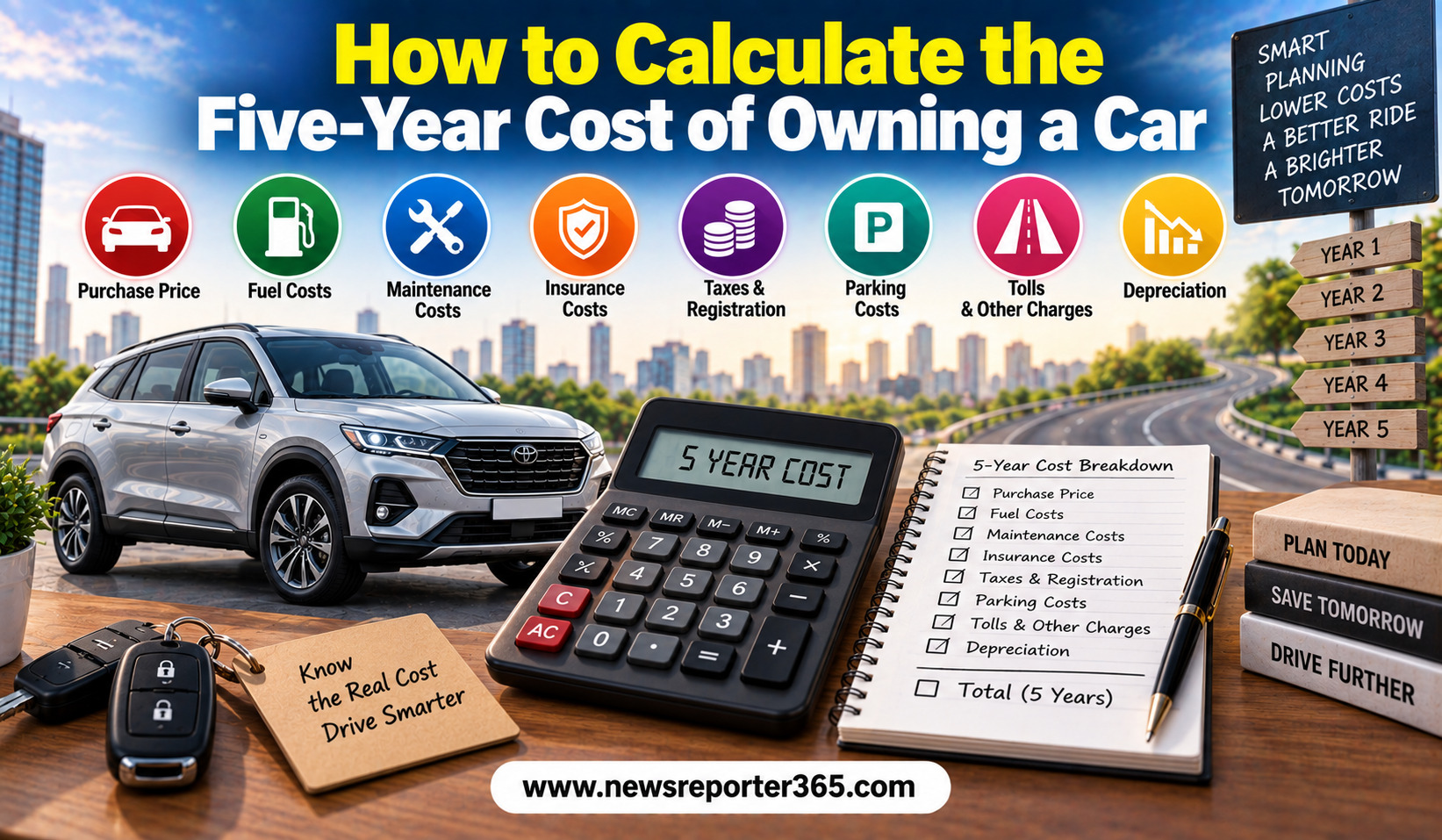
Buying a car is often seen as a one-time financial decision, but the actual cost continues long after the vehicle leaves the dealership. The ex-showroom or on-road price may be the biggest expense at the beginning, yet fuel, insurance, maintenance, repairs, financing and depreciation can add significantly to the total amount spent over several years.
For buyers trying to choose between different cars, calculating the five-year cost of ownership can provide a more realistic picture. A vehicle with a lower purchase price is not automatically cheaper to own. Another car may cost more initially but offer better fuel efficiency, lower maintenance requirements or stronger resale value.
A five-year calculation brings these different expenses together and helps buyers understand what they are likely to spend during a typical ownership period. While the exact amount will vary from one driver to another, the method can be applied to almost any new or used car.
What Does Five-Year Ownership Cost Mean?
The five-year ownership cost is an estimate of the total money spent on a vehicle during five years, after accounting for the major costs associated with purchasing and using it.
A simple way to calculate it is:
Five-Year Ownership Cost = Purchase Cost + Financing Cost + Running Costs + Maintenance + Insurance + Other Expenses – Resale Value
The formula is not intended to predict every rupee a driver will spend. Instead, it provides a framework for comparing vehicles.
The purchase cost should normally be based on the on-road price rather than only the ex-showroom price. This gives a more realistic starting point because registration, applicable taxes and insurance-related costs can form a significant part of the initial bill.
Step One: Start With the On-Road Price
The first figure to record is the actual on-road price of the car. This can vary depending on the state, city, variant and insurance selection.
Suppose a vehicle has an on-road price of ₹10 lakh. That ₹10 lakh becomes the starting point of the five-year calculation. If the buyer pays the entire amount upfront, there may be no loan interest to add. If the vehicle is financed, however, the total amount paid to the lender needs to be considered.
Buyers should also separate optional accessories from mandatory expenses. Expensive accessories, extended warranties and service packages can increase the initial ownership cost, but they should be included only if the buyer actually intends to purchase them.
Step Two: Calculate the Financing Cost
Many car buyers use loans, making interest an important part of the ownership calculation. The amount borrowed, interest rate and loan tenure all influence the final cost.
For example, a buyer may purchase a ₹10 lakh car with a ₹3 lakh down payment and finance the remaining ₹7 lakh. The total amount eventually paid to the lender will be higher than ₹7 lakh because of interest and potentially other loan-related charges.
The simplest method is to check the lender’s repayment schedule and calculate the total amount paid during the five-year period. If the loan is cleared earlier, the calculation should reflect the actual repayment plan.
Buyers should avoid focusing only on the EMI. A low monthly payment can sometimes result from a longer loan tenure, which may increase the total interest paid.
Step Three: Estimate Fuel or Charging Costs
For most drivers, fuel or charging becomes one of the largest recurring ownership expenses.
To calculate petrol or diesel expenses, start with the expected annual kilometres. Then estimate the vehicle’s realistic fuel efficiency and multiply the resulting fuel requirement by the expected fuel price.
For example, assume a car travels 12,000 km each year and delivers an estimated real-world efficiency of 15 km per litre. The approximate annual fuel requirement would be 800 litres. If the average fuel price used for planning is ₹100 per litre, annual fuel spending would be about ₹80,000.
Over five years, that would amount to approximately ₹4 lakh, assuming mileage and fuel prices remain unchanged.
This is only an estimate. Real-world fuel economy can vary because of traffic, driving style, road conditions, air-conditioning use and vehicle load. Fuel prices can also change considerably over five years.
For an electric car, the same concept can be applied using estimated electricity consumption and charging costs.
Step Four: Add Insurance Costs
Insurance should be included for every year of the five-year ownership period. The first-year premium may already be part of the on-road purchase price, depending on the quotation, so buyers should avoid counting it twice.
Future insurance renewals can vary based on the insurer, coverage, vehicle value, claim history and selected add-ons. Rather than assuming the exact future premium, buyers can use a reasonable estimate for annual renewal costs.
A five-year calculation should therefore include the initial insurance cost where applicable and estimated renewal premiums for subsequent years.
Step Five: Estimate Routine Maintenance
Regular servicing is another predictable ownership expense. Depending on the vehicle, scheduled maintenance may include engine oil, filters, brake inspections, fluid replacement and other service-related work.
The manufacturer’s service schedule can provide a useful starting point for estimating these costs. Buyers can also ask dealerships or service centres for an approximate five-year maintenance schedule.
Maintenance costs are particularly useful when comparing cars from different segments. A premium vehicle may have more expensive parts and servicing than a smaller mass-market car.
| Cost Category | What to Include | Five-Year Calculation |
| Initial purchase | On-road price | One-time |
| Loan | Interest and applicable charges | Based on repayment schedule |
| Fuel/charging | Annual usage and energy cost | Annual cost × 5 |
| Insurance | Initial and renewal premiums | Estimated five-year total |
| Maintenance | Scheduled servicing | Add expected services |
| Repairs | Wear and unexpected repairs | Keep a contingency amount |
| Tyres/battery | Replacement when required | Add estimated replacement cost |
| Depreciation | Purchase value minus resale value | Calculate at end |
| Other costs | Parking, tolls, cleaning, etc. | Based on actual usage |
Step Six: Don’t Forget Tyres and Wear-and-Tear Items
Routine servicing is not the only maintenance expense. Tyres, brake components, batteries and other wear-and-tear parts may eventually require replacement.
Tyre replacement can be particularly important in a five-year calculation. The replacement interval depends on mileage, driving conditions, tyre quality and maintenance. Cars equipped with larger wheels can also have more expensive replacement tyres.
The 12-volt battery in a conventional vehicle may also need replacement during the ownership period. Electric vehicles have different maintenance requirements, although tyres and other conventional wear components still need attention.
It is difficult to predict unexpected repairs accurately, so setting aside a contingency amount can make the five-year estimate more realistic.
Step Seven: Include Parking, Tolls and Other Regular Expenses
Daily use can generate smaller expenses that become meaningful when accumulated over several years. Paid parking, highway tolls, car washing, detailing and occasional accessories can all contribute to the ownership bill.
Not every driver will have the same expenses. Someone who works from home may spend very little on parking, while a city commuter could face regular parking charges.
The best approach is to look at your expected driving routine and include only the expenses that are genuinely relevant to your ownership pattern.
Some commonly overlooked costs include:
- Paid parking
- Highway tolls
- Regular car cleaning
- Pollution or compliance-related expenses where applicable
Step Eight: Calculate Depreciation and Resale Value
Depreciation is one of the most important parts of the five-year calculation because it represents the value the vehicle loses over time.
Suppose a car costs ₹10 lakh when purchased and can be sold for an estimated ₹5.5 lakh after five years. The depreciation is approximately ₹4.5 lakh.
That ₹4.5 lakh should be considered part of the cost of owning the vehicle. It is not a monthly payment, but it represents money that has effectively been lost from the vehicle’s original value.
Resale value depends on the model, condition, mileage, service history and used-car market demand. It cannot be predicted with complete certainty, so buyers should use a reasonable estimate rather than assuming a guaranteed future price.
A Simple Five-Year Example
Consider a hypothetical car purchased for an on-road price of ₹10 lakh. Assume the owner drives 12,000 km annually, spends approximately ₹80,000 per year on fuel, pays around ₹25,000 annually for insurance after the initial period, and spends an average of ₹20,000 per year on maintenance and routine expenses.
If the car is worth approximately ₹5.5 lakh after five years, the calculation could look something like this:
| Expense | Approximate Five-Year Amount |
| Initial on-road purchase | ₹10,00,000 |
| Fuel | ₹4,00,000 |
| Insurance renewals | ₹1,00,000 |
| Maintenance | ₹1,00,000 |
| Other running expenses | ₹50,000 |
| Estimated resale value | -₹5,50,000 |
| Estimated ownership cost | ₹11,00,000 |
This is a hypothetical example rather than a prediction for a particular car. It also excludes financing interest, which would need to be added if the vehicle is purchased with a loan.
The example demonstrates why the original purchase price alone cannot explain the real cost of owning a car.
Compare Cars Using Cost Per Year or Per Kilometre
Once the five-year total has been calculated, buyers can make comparisons easier by converting the amount into an annual or per-kilometre figure.
If the five-year ownership cost is ₹11 lakh, the average cost is ₹2.2 lakh per year. If the car travels 60,000 km over five years, the estimated ownership cost works out to around ₹18.33 per kilometre.
This method can be particularly useful when comparing petrol, diesel, hybrid and electric vehicles, provided the assumptions used for each vehicle are reasonable and consistent.
Why Realistic Assumptions Matter
A five-year ownership calculation is only as useful as the assumptions behind it. Using an unrealistically high fuel efficiency figure or ignoring future maintenance can make one vehicle appear cheaper than it really is.
Buyers should ideally use conservative estimates for fuel economy and resale value. It is also useful to calculate a low-cost and high-cost scenario to understand how much the final figure could change.
Fuel prices, insurance premiums and maintenance requirements can all change over five years, so the result should be treated as a planning estimate rather than an exact forecast.
Final Word
Calculating the five-year cost of owning a car gives buyers a clearer understanding of what they are actually committing to financially. The purchase price is only the beginning. Fuel or charging, insurance, servicing, tyres, repairs, financing and depreciation can collectively make a substantial difference.
The best way to compare two cars is therefore not simply to compare their showroom prices. Instead, buyers should estimate their complete ownership costs and consider the expected resale value at the end of the planned ownership period.
A car that costs slightly more to buy may ultimately be cheaper to own if it has better efficiency, manageable maintenance expenses and stronger resale value. Conversely, a lower-priced vehicle can become expensive if its running and depreciation costs are significantly higher.
A five-year ownership calculation may take a little extra effort before buying, but it can help prevent unpleasant financial surprises later.
FAQs
What is the five-year cost of owning a car?
It is an estimate of the total financial cost of purchasing and using a car for five years, including purchase price, fuel or charging, insurance, maintenance, financing and depreciation, minus the vehicle’s resale value.
Does the calculation include the car’s resale value?
Yes. Resale value should be deducted from the total ownership expenses because it represents money that can potentially be recovered when the vehicle is sold.
Is fuel the biggest five-year car expense?
It can be for drivers who cover high annual mileage, but the biggest costs vary between vehicles and users. Depreciation, financing, insurance and maintenance can also have a major impact.
Should EMI be included in the five-year ownership calculation?
The loan’s interest and applicable financing charges should be included. Buyers should avoid simply adding every EMI if the calculation already includes the original purchase amount, because that can count the principal twice.
How can I calculate fuel costs?
Estimate annual kilometres, divide that figure by realistic fuel efficiency to determine annual fuel consumption, and multiply it by the estimated fuel price. Multiply the annual figure by five for a basic five-year estimate.