

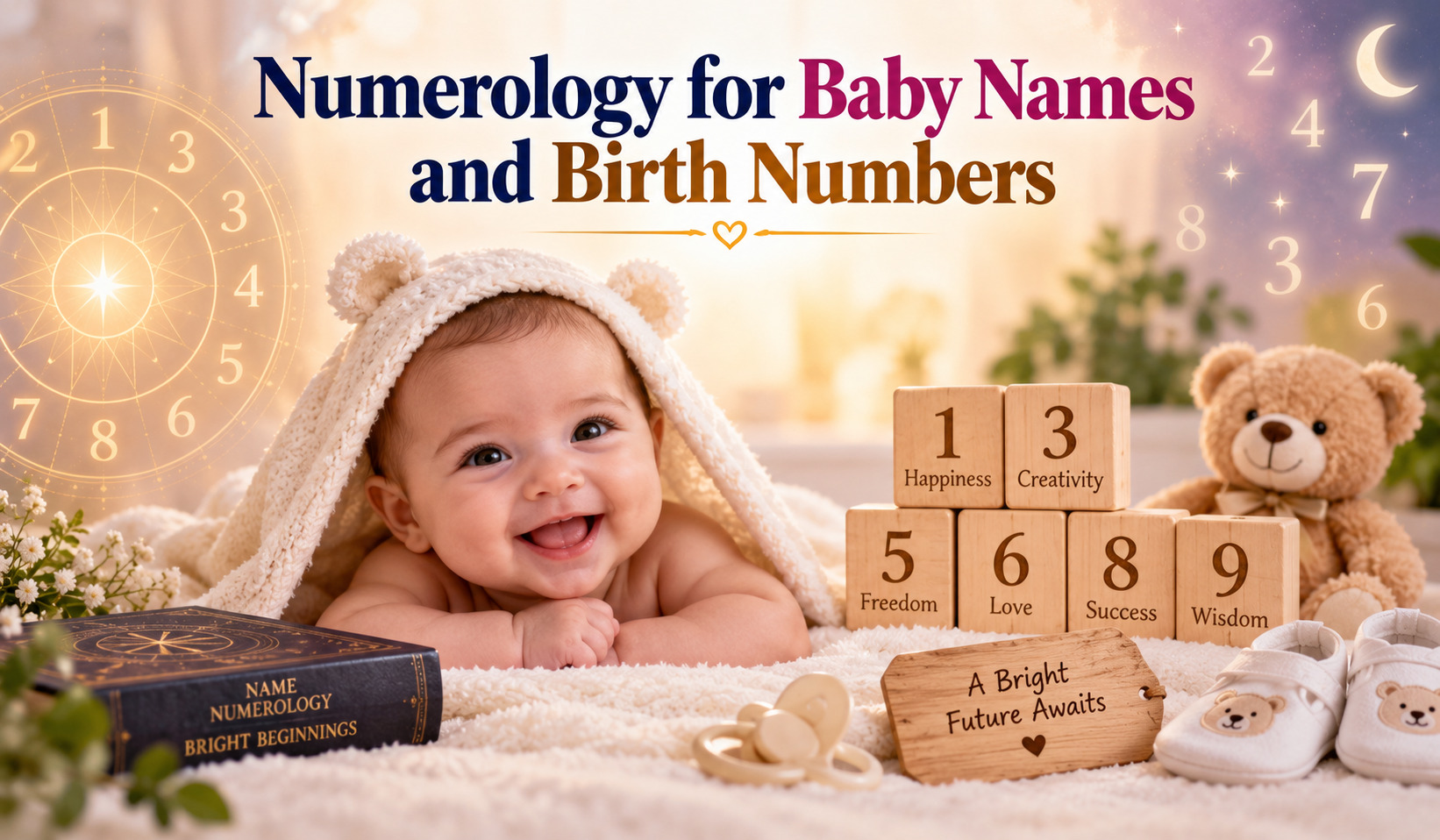
Choosing a baby’s name is one of the first major decisions parents make. While many families look at meaning, family traditions, culture, and modern naming trends, numerology has also become an interesting factor for parents who believe that numbers can carry symbolic significance. In numerology, a baby’s birth date and name are often studied together to understand personality traits, strengths, challenges, and possible life patterns.
The idea behind numerology for baby names is that letters can be converted into numbers, while a child’s birth date can be reduced to a significant number. Supporters of the practice believe that the relationship between these numbers can help parents select a name that feels harmonious with the child’s birth number.
However, numerology is a spiritual or belief-based practice rather than a scientifically proven method for predicting a child’s personality or future. Parents can use it as a cultural or personal naming tradition while also considering the meaning, pronunciation, and practicality of the name.
What Is a Birth Number in Numerology?
A birth number is generally calculated from the day a child is born. Unlike the Life Path Number, which uses the complete date of birth, the Birth Number traditionally focuses on the date of the month.
For example, if a baby is born on the 14th of a month, the calculation is:
1 + 4 = 5
The baby’s Birth Number would therefore be 5.
If the baby is born on a single-digit date such as the 6th, the number remains 6. For dates from 10 to 31, numerology practitioners generally reduce the two-digit number to a single digit.
Some numerologists also examine the complete date of birth to calculate a Life Path Number. This creates another layer of interpretation and allows parents to compare the baby’s name number with both the Birth Number and Life Path Number.
Baby Names and Numerology Numbers
In name numerology, each letter of a name is assigned a numerical value according to a particular numerology system. The values are then added together and reduced to a single number.
The exact calculation can differ depending on whether a practitioner follows the Pythagorean, Chaldean, or another numerology tradition. Because different systems use different letter values, the same name may produce different results.
For this reason, parents should decide which system they want to follow before comparing names. Switching between systems during the selection process can lead to inconsistent results.
The final number associated with a name is often called the Name Number. Numerologists may then compare this number with the baby’s Birth Number to determine whether they believe the two numbers are compatible.
Why Are Parents Interested in Numerology for Baby Names?
A baby’s name can carry emotional, cultural, and family significance. Numerology adds another way for parents to think about the choice. Instead of selecting a name only because it sounds attractive, some parents consider whether its numerical symbolism matches qualities they hope their child will develop.
For instance, parents who associate the number 3 with creativity and communication may look for names that produce that number. Others may prefer numbers traditionally connected with stability, leadership, compassion, or knowledge.
Numerology can also become part of a family’s naming ceremony or cultural tradition. In some communities, names are selected after considering birth details, astrology, numerology, or advice from elders and spiritual practitioners.
The growing availability of online numerology calculators has also made these calculations easier for parents to explore.
Common Numerology Meanings for Baby Birth Numbers
Each number is traditionally associated with certain characteristics. These interpretations are not universal, but they provide a general framework used by many numerology followers.
| Birth Number | Traditional Association |
| 1 | Leadership, independence, confidence |
| 2 | Cooperation, sensitivity, balance |
| 3 | Creativity, communication, expression |
| 4 | Discipline, practicality, stability |
| 5 | Freedom, curiosity, adaptability |
| 6 | Family, care, responsibility |
| 7 | Knowledge, spirituality, reflection |
| 8 | Ambition, authority, achievement |
| 9 | Compassion, generosity, wisdom |
These meanings should not be treated as fixed descriptions of a child’s personality. A child’s character develops through many influences, including family relationships, education, environment, experiences, and individual choices.
How Parents Can Compare a Name With a Birth Number
Once parents know the baby’s Birth Number, they can calculate the numerical value of shortlisted names. The next step is to compare the Name Number with the Birth Number according to the chosen numerology system.
For example, imagine a baby has a Birth Number of 3. Parents might examine several names and find that one produces a Name Number of 3, another produces 6, and another produces 8. A numerology practitioner may interpret each combination differently.
There is no universally accepted rule saying that the Name Number must exactly match the Birth Number. Some practitioners prefer matching numbers, while others believe complementary numbers can work well together.
Therefore, parents should avoid rejecting a meaningful name solely because its numerical value does not match perfectly.
Birth Number vs Life Path Number
One common source of confusion is the difference between a Birth Number and a Life Path Number. They are calculated differently and may be interpreted differently.
The Birth Number generally comes from the day of birth, while the Life Path Number uses the complete date of birth. For example, a child born on 18 July 2026 would have a Birth Number calculated from 18:
1 + 8 = 9
The complete date can then be used for a Life Path calculation:
1 + 8 + 7 + 2 + 0 + 2 + 6 = 26
Then:
2 + 6 = 8
In this example, the Birth Number is 9 while the Life Path Number is 8. A numerologist may examine both numbers when considering a name.
Should the Name Match the Baby’s Birth Number?
There is no requirement within numerology that a baby’s name must have exactly the same number as the Birth Number. In fact, different numerology practitioners may have completely different recommendations.
Some believe that matching numbers can strengthen particular qualities. Others prefer numbers that complement one another and create a balanced combination.
For parents, the most practical approach is to treat numerical compatibility as one factor among many. A name should also have a positive meaning, be comfortable to pronounce, and fit the family’s cultural and personal preferences.
A simple approach when using numerology can include:
- Calculate the baby’s Birth Number.
- Calculate the Life Path Number if desired.
- Shortlist names based on meaning and family preferences.
- Calculate the Name Numbers of the shortlisted names.
- Compare the results without treating them as guarantees.
Numerology and Cultural Naming Traditions
Numerology is sometimes combined with other naming traditions. Families may consider grandparents’ names, religious customs, regional languages, astrology, nakshatra-based naming, or the meanings of Sanskrit and other traditional names.
In India, for example, parents may explore several naming methods before making a final decision. A name can be selected because it reflects a deity, a virtue, nature, family history, or a traditional linguistic meaning, with numerology considered afterward.
This combination allows parents to preserve cultural identity while also incorporating a personal interest in numbers.
What Should Parents Consider Before Finalizing a Name?
Numerology can be interesting, but it should not become the only deciding factor. A name is something a child may use throughout life, so practical considerations deserve equal attention.
Parents should think about whether the name is easy to pronounce, how it sounds with the family surname, whether its spelling could cause confusion, and whether its meaning is positive.
It can also be useful to consider how the name works in different stages of life. A name that sounds appealing for a newborn should also feel appropriate for a student, professional, and adult.
Most importantly, parents should choose a name because they genuinely value it rather than because they are worried that another number could bring bad luck.
Conclusion
Numerology for baby names and Birth Numbers offers parents an additional perspective when choosing a name for their child. By calculating the Birth Number, understanding traditional numerical meanings, and comparing potential Name Numbers, families can make the naming process more personal and meaningful.
At the same time, numbers should not be treated as a fixed prediction of a child’s personality or future. A child’s development depends on countless factors that cannot be reduced to a single number.
Frequently Asked Questions
What is a baby’s Birth Number?
A Birth Number is traditionally calculated using the day of the month on which a baby is born. Two-digit dates are usually reduced to a single digit.
How is a baby name number calculated?
Letters in the baby’s name are assigned numerical values according to a particular numerology system. The values are added together and generally reduced to a single digit.
Should a baby’s name number match the Birth Number?
Not necessarily. Some numerologists prefer matching numbers, while others look for complementary combinations. There is no single universal rule.
What is the difference between Birth Number and Life Path Number?
The Birth Number generally comes from the day of birth, while the Life Path Number is calculated using the complete date of birth.
Is numerology scientifically proven?
No. Numerology is considered a belief-based or spiritual practice and does not have established scientific evidence showing that numbers determine personality or future events.