

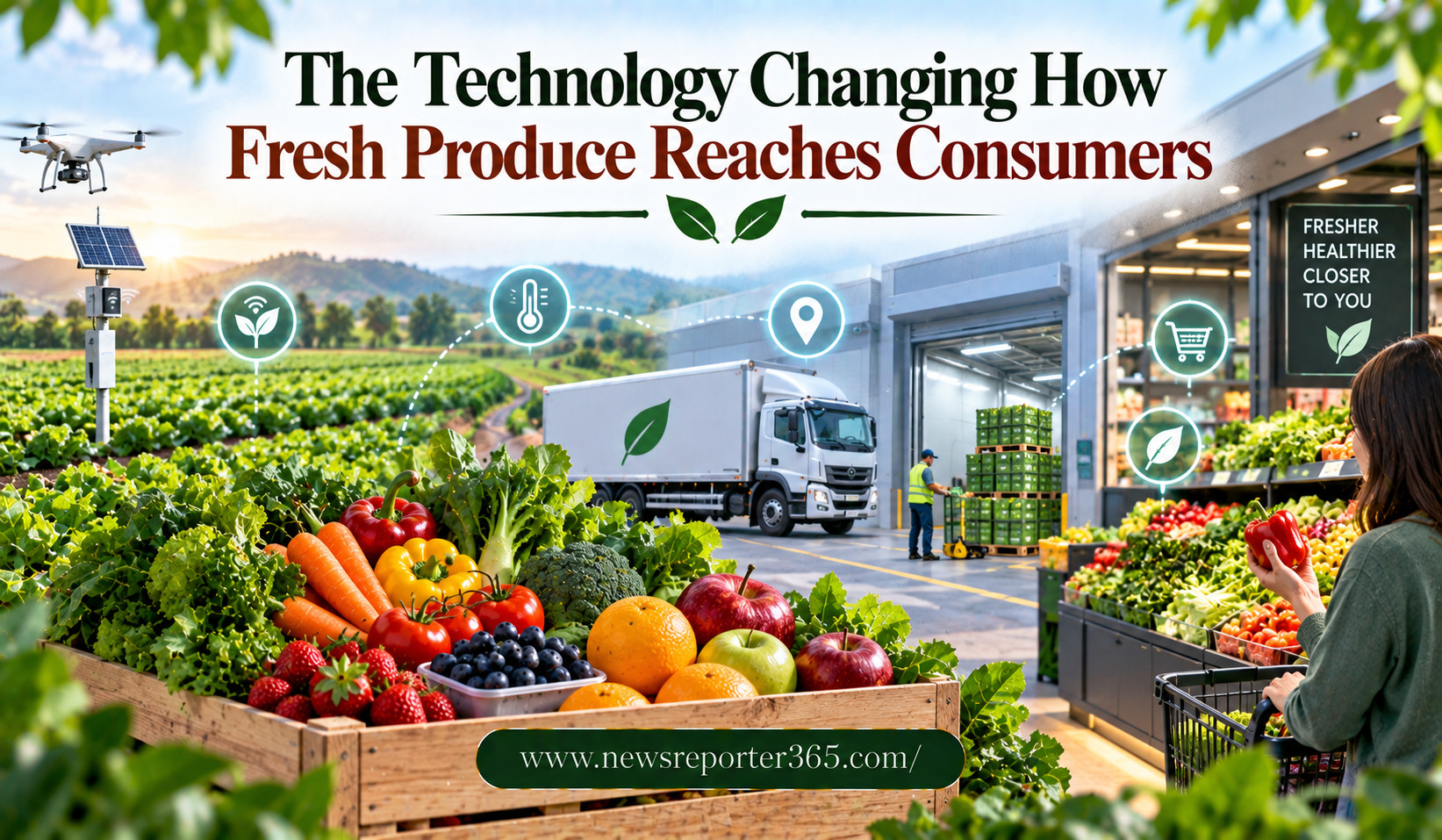
Technology is changing the way fresh fruits and vegetables move from farms to consumers. What was once a largely traditional supply chain involving farmers, traders, wholesalers, transporters and local markets is becoming increasingly connected through digital tools, data systems and modern logistics.
Fresh produce presents a unique challenge for the food industry because fruits and vegetables can lose quality quickly. Temperature, humidity, transportation time, handling and storage conditions can all influence freshness. As demand for convenient and reliable food continues to grow, technology is being used to make these processes more efficient.
From digital marketplaces that connect farmers with buyers to sensors that monitor produce during transportation, new systems are gradually changing how fresh food is sourced, stored and delivered.
From Traditional Markets to Digital Supply Chains
Traditionally, fresh produce has passed through several stages before reaching consumers. Farmers harvest crops, after which produce may move through collection centres, wholesalers and retailers before finally reaching a household.
Every additional stage can add time and handling. Technology is now helping businesses coordinate these steps more efficiently. Digital platforms can connect producers, distributors and retailers while providing information about orders, inventory and transportation.
This does not mean traditional markets are disappearing. Instead, digital systems are increasingly being added to existing supply chains. A retailer, for example, may use software to monitor inventory while continuing to purchase produce through established suppliers.
The result is a more connected system in which information can move faster even when the physical movement of produce remains similar.
Data Is Becoming an Important Part of Fresh Produce
One of the biggest changes is the growing use of data. Farmers and supply-chain companies can collect information about crop production, demand, prices, inventory and transportation.
This information can help businesses make decisions about how much produce needs to be harvested, stored or transported. Better demand information may also help reduce situations where excessive quantities reach markets when consumer demand is low.
For consumers, the impact may not always be visible. They may simply notice better availability or more consistent quality. Behind that experience, however, digital systems can be helping companies coordinate thousands of individual products.
Smart Sensors Can Monitor Produce During Transport
Fresh produce can be affected by environmental conditions while it is being transported. Technology such as temperature and humidity sensors can help companies monitor those conditions.
Sensors can collect information during transportation and storage. If conditions move outside a desired range, supply-chain operators may receive alerts and take corrective action.
This type of monitoring can be particularly relevant for produce that is sensitive to temperature changes. Instead of relying entirely on manual checks after a shipment arrives, companies can gain information about conditions throughout the journey.
| Technology | Main use | Potential benefit |
| Temperature sensors | Monitor storage and transport conditions | Helps identify temperature problems |
| GPS tracking | Track shipments and vehicles | Improves delivery visibility |
| Digital inventory systems | Monitor stock levels | Supports better replenishment |
| QR codes | Provide product information | Improves traceability |
| Data analytics | Study demand and supply patterns | Supports planning |
| Automated sorting | Classify produce by characteristics | Can improve processing efficiency |
These technologies do not eliminate every supply-chain problem, but they can provide businesses with more information and greater control.
Cold-Chain Technology Is Getting Smarter
Maintaining suitable temperatures from harvest to retail is an important part of fresh-produce logistics. Refrigerated vehicles, cold storage facilities and temperature monitoring systems form part of what is commonly known as the cold chain.
Technology is helping make these systems more measurable. Digital monitoring can provide information about temperature conditions instead of relying only on manual records.
Modern cold-chain systems can combine sensors, tracking software and automated alerts. This can help operators identify problems earlier and potentially reduce losses caused by unsuitable storage or transportation conditions.
However, technology alone cannot solve cold-chain challenges. Reliable electricity, suitable infrastructure, trained workers and well-maintained equipment are also necessary.
Artificial Intelligence Is Entering Produce Supply Chains
Artificial intelligence and machine-learning systems are increasingly being explored for food and agricultural applications. In fresh produce, data-driven systems can potentially help forecast demand, identify patterns and support supply-chain decisions.
For example, historical sales information can be analyzed to estimate future demand for particular products. Businesses can then use these insights when planning orders and transportation.
AI-based computer vision is another developing area. Cameras and software can analyze products for characteristics such as size, colour and visible defects. Automated systems may help sort large quantities of produce more quickly than manual inspection alone.
These applications are still developing, and their usefulness depends heavily on data quality, infrastructure and how accurately systems are implemented.
Digital Platforms Are Connecting Farmers and Buyers
Technology is also changing how produce is bought and sold. Digital marketplaces can connect farmers, wholesalers, retailers and institutional buyers.
Instead of relying entirely on physical markets to discover buyers, producers may have access to online platforms where demand can be displayed and orders can be coordinated.
This can improve communication between different parts of the supply chain. Farmers can receive information about demand, while buyers can potentially gain access to a wider range of suppliers.
However, digital platforms work best when participants have reliable internet access, appropriate digital skills and transparent systems for payments and transactions.
Online Grocery Shopping Is Changing Consumer Expectations
The growth of online grocery shopping has created another major change. Consumers can now order fruits and vegetables through websites and mobile applications and receive them at home.
This has increased expectations around delivery speed and product quality. Consumers may expect fresh products to arrive quickly, while retailers need to coordinate inventory and delivery operations carefully.
Unlike packaged products, fresh produce can vary in size, appearance and ripeness. Online retailers therefore need systems that can manage these variations while maintaining customer satisfaction.
Some businesses are using centralized fulfilment centres, while others rely on stores or local warehouses to prepare online orders.
Traceability Is Becoming More Important
Consumers and businesses are also showing greater interest in knowing where food comes from. Digital traceability systems can help record information about a product as it moves through different stages of the supply chain.
QR codes and digital records can potentially provide details about the origin, processing or movement of produce. For businesses, traceability can also support quality management and help identify where problems occurred.
A traceability system becomes particularly useful when a food-safety issue needs to be investigated. The ability to follow products through the supply chain can help companies identify affected batches more efficiently.
The level of information available to consumers varies considerably between businesses and products, so a QR code does not automatically mean that a product has complete end-to-end traceability.
Automation Is Changing Sorting and Packing
Fresh produce requires substantial sorting and packing before reaching consumers. Automation is increasingly being used for some of these tasks.
Machines equipped with cameras and sensors can evaluate produce based on factors such as size, shape and appearance. Automated packing systems can then organize products for transportation.
Automation may improve consistency and speed, particularly in large processing facilities. It can also reduce the amount of repetitive manual work required.
However, human workers remain important across the fresh-produce industry. Harvesting, quality decisions, maintenance, logistics management and many other tasks still require human involvement.
Four Ways Technology Can Improve the Fresh-Produce Journey
The growing use of digital tools can influence several stages of the supply chain:
- Better visibility: Businesses can track shipments and inventory more closely.
- Faster decisions: Real-time data can help operators respond to supply or demand changes.
- Quality monitoring: Sensors can provide information about environmental conditions.
- Improved coordination: Digital platforms can connect different participants in the supply chain.
These benefits depend on how well the technology is integrated into actual operations.
Technology Could Also Help Reduce Food Waste
Food waste is a major concern throughout agricultural supply chains. Produce may be lost because of damage, spoilage, delays, poor storage or inaccurate demand forecasting.
Technology cannot prevent all of these losses, but better information may help reduce some avoidable waste. Demand forecasting can support purchasing decisions, while temperature monitoring can help identify storage problems.
Digital inventory systems can also help retailers know which products need to be sold or replenished first.
Reducing waste requires more than technology, though. Packaging, transportation infrastructure, consumer behaviour, market conditions and agricultural practices all influence how much food reaches consumers.
What This Means for Consumers
For shoppers, the biggest changes may appear as convenience rather than visible technology. Consumers may receive faster grocery deliveries, find more consistent availability or access information about where certain produce originated.
At the same time, technology could change the way consumers interact with fresh food. Digital platforms may provide information about seasonality, origin and storage, while online ordering makes regional and specialty produce easier to discover.
The challenge will be ensuring that technological improvements actually translate into better quality, affordability and accessibility rather than simply adding costs to the supply chain.
The Road Ahead for Fresh Produce Technology
The fresh-produce industry is likely to become increasingly connected as digital tools become more accessible. Sensors, artificial intelligence, automated sorting, online marketplaces and traceability systems could become more common across different stages of the journey from farm to consumer.
Smaller producers may adopt technology gradually, depending on cost and access to infrastructure. Large retailers and logistics companies may continue investing in sophisticated data systems because of the scale of their operations.
The future is unlikely to be based on one single technology. Instead, several systems may work together, linking agricultural production with transportation, storage, retail and consumer demand.
Conclusion
Technology is gradually transforming the journey fresh produce takes from farms to consumers. Digital marketplaces, sensors, artificial intelligence, automated sorting, cold-chain monitoring and online grocery systems are creating a more connected supply chain.
The changes are not limited to large technology companies. Farmers, retailers, logistics providers and consumers are all becoming part of a food system in which information plays a larger role.
As these technologies develop, the focus will increasingly be on whether they can deliver practical improvements in freshness, efficiency, traceability, convenience and waste reduction. The modern fresh-produce journey may still begin on a farm, but increasingly, its path to the consumer is being shaped by data and digital technology.
FAQs
How is technology changing fresh-produce supply chains?
Technology is helping businesses monitor inventory, track shipments, forecast demand, manage storage conditions and connect producers with buyers.
Can technology keep fruits and vegetables fresh for longer?
Technology such as cold-chain equipment and environmental sensors can help maintain suitable storage and transportation conditions. However, it cannot stop natural deterioration completely.
How does AI help the fresh-produce industry?
AI can be used for applications such as demand forecasting, data analysis and computer-vision-based sorting. Its effectiveness depends on the quality of available data and the implementation of the system.
Can consumers track where their produce came from?
Some companies use digital traceability systems and QR codes to provide information about product origin or movement. The amount of information available varies by product and supplier.
Does technology reduce food waste?
Technology can potentially reduce certain forms of waste by improving demand forecasting, inventory management and storage monitoring. It is one part of a much larger food-waste solution.