

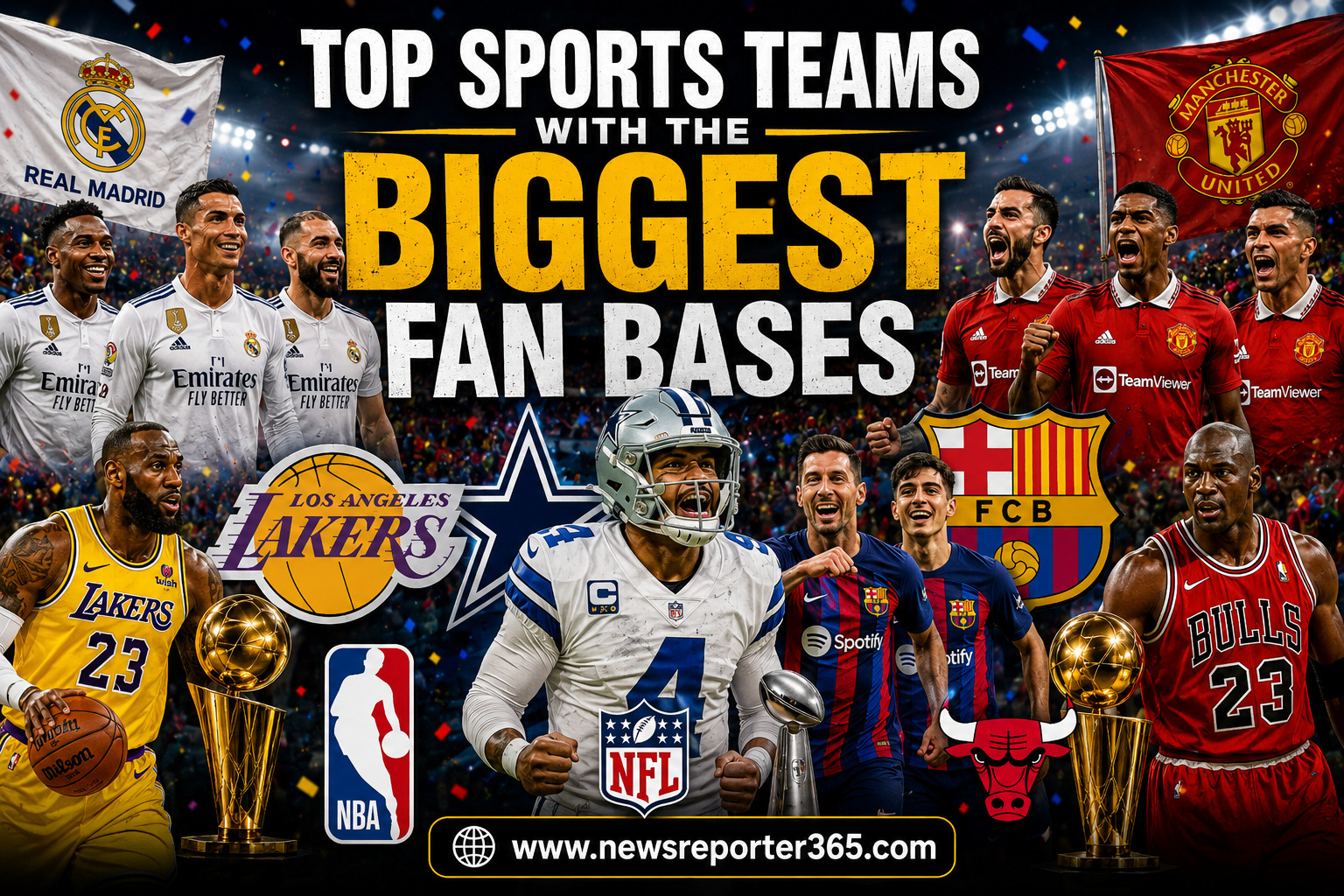
Sports teams are no longer supported only by people living near their home stadiums. In the digital age, a successful team can build a following that stretches across continents, generations and cultures. A club in Europe can have millions of supporters in Asia, while an American franchise can attract fans from almost every major sports market.
The biggest fan bases in sports are built through a combination of history, trophies, iconic players, rivalries, culture and constant digital engagement. Winning certainly helps, but it is not the only reason a team becomes globally popular. Some organizations have enormous followings because generations of supporters have passed their loyalty to their children, creating a powerful connection that survives periods of poor performance.
Football clubs dominate many discussions about global fan bases because of the sport’s worldwide popularity. Real Madrid, Barcelona and Manchester United have developed enormous international communities. In cricket, India commands exceptional support, while teams such as the Chennai Super Kings and Mumbai Indians have created huge followings through the Indian Premier League. American franchises including the Los Angeles Lakers, Dallas Cowboys and Golden State Warriors also possess global audiences.
There is no single official measurement for the world’s biggest fan base. Social media followers, television audiences, merchandise sales, stadium attendance and survey-based estimates can all produce different results. Therefore, the teams discussed here should be viewed as some of the world’s most globally supported sports organizations rather than a definitive ranking based on one metric.
Real Madrid: A Global Football Giant
Real Madrid is one of the strongest examples of how sporting success can create a worldwide fan community.
The Spanish club’s appeal has been built over more than a century. European championships, legendary players and a history of attacking football have made the team one of the most recognizable names in global sport.
Players such as Cristiano Ronaldo, Zinedine Zidane, Ronaldo Nazário, David Beckham and many others have helped expand the club’s popularity far beyond Spain.
Real Madrid’s fan base has also benefited from its enormous digital presence. Supporters can follow matches, training sessions, transfer news and player content through social media platforms, allowing the club to remain connected with fans who may never visit the Santiago Bernabéu.
The club’s commercial strength reflects this international reach. Forbes valued Real Madrid at approximately $9.5 billion in 2026, making it the world’s most valuable soccer club for the fifth consecutive year. The club also generated approximately $1.27 billion in revenue during the 2024-25 season.
These figures demonstrate how sporting popularity and global commercial reach are closely connected.
Barcelona: More Than a Football Club
Barcelona has developed one of the most distinctive identities in world football.
Its famous philosophy, youth development system and long list of legendary players have attracted supporters across Europe, Asia, Africa and the Americas.
The Lionel Messi era played a particularly important role in expanding Barcelona’s international following. Messi became one of the most recognizable athletes on the planet while playing for the club, creating millions of new supporters.
Barcelona’s famous identity has also helped the team develop a strong cultural connection with its supporters. The club’s slogan and association with Catalan culture make its identity different from that of many other major football organizations.
Even during periods of financial and sporting difficulty, Barcelona continues to command enormous global attention.
Its supporters regularly engage with club content online, follow transfer developments and purchase official merchandise, demonstrating that fan loyalty can survive changes in sporting performance.
Manchester United: A Worldwide Community
Manchester United has one of the most recognizable sports brands in the world.
The club’s international popularity developed significantly during the successful era under Sir Alex Ferguson. Premier League titles, Champions League victories and generations of famous players helped Manchester United build an enormous following outside England.
Players such as David Beckham, Cristiano Ronaldo, Wayne Rooney and Ryan Giggs became global sporting celebrities while wearing the famous red shirt.
Manchester United’s commercial partnerships have also reflected its international popularity. The club has supporters throughout Asia, Africa, North America and the Middle East.
Unlike many teams whose popularity depends heavily on current results, Manchester United continues to attract substantial global attention even during rebuilding periods.
This is one of the clearest signs of a truly established fan base. A team does not need to win every season to maintain international loyalty.
Bayern Munich: Germany’s Most Supported Football Brand
Bayern Munich has established itself as Germany’s dominant football club and one of Europe’s most successful sporting institutions.
Its consistent domestic success has created generations of supporters, while Champions League triumphs have strengthened its international profile.
The club’s connection with German football culture is particularly strong, but its reach extends well beyond Germany.
Bayern has built international fan communities, supporter clubs and digital audiences around the world. Its recognizable red colors and history of elite players make it easy for international supporters to identify with the club.
The team’s success has also been helped by players who became global stars, including Franz Beckenbauer, Gerd Müller, Oliver Kahn, Philipp Lahm and Robert Lewandowski.
Liverpool: A Fan Base Built on History and Emotion
Liverpool’s supporters are among the most passionate in world football.
The club’s history, European success and famous matchday atmosphere have created a powerful identity.
The emotional connection between Liverpool and its supporters is particularly visible through traditions surrounding Anfield. Songs, rituals and community identity have helped create a sense of belonging that goes beyond watching football.
Liverpool’s popularity increased further during its successful Premier League and Champions League campaigns in recent years.
The club also has large international supporter communities, particularly in Asia and other regions where English football has a substantial following.
Liverpool demonstrates that a fan base can be built not only through trophies but also through culture and emotional connection.
Los Angeles Lakers: Basketball’s Global Superstar
The Los Angeles Lakers are arguably the most recognizable basketball team in the world.
The franchise has benefited from an extraordinary history featuring players such as Magic Johnson, Kareem Abdul-Jabbar, Shaquille O’Neal, Kobe Bryant and LeBron James.
Each generation of superstar has introduced the Lakers to a new group of fans.
Kobe Bryant was particularly influential in developing the team’s international following. His popularity across Asia and Europe helped make the Lakers a global basketball brand.
The team’s Los Angeles location also provides access to Hollywood, entertainment and international media.
Forbes valued the Lakers at approximately $10 billion in its 2025 global sports-team ranking, placing them among the world’s five most valuable sports franchises.
Their financial strength is closely connected to their enormous commercial and fan appeal.
Golden State Warriors: The Curry Effect
The Golden State Warriors have experienced a remarkable increase in global popularity during the Stephen Curry era.
Before Curry and the team’s championship run, the Warriors were not traditionally viewed as one of the NBA’s biggest global brands.
The transformation was dramatic.
Curry’s three-point shooting, personality and influence on modern basketball attracted fans around the world. The team’s success during the 2010s turned the Warriors into one of the most recognizable sports organizations in the United States.
Forbes valued the Warriors at approximately $11 billion in its 2025 ranking, making them the world’s second-most valuable sports franchise behind the Dallas Cowboys.
The Warriors show how one superstar and a successful playing style can completely transform a team’s global identity.
Dallas Cowboys: America’s Team
The Dallas Cowboys are one of the most commercially powerful sports teams in the United States.
Their nickname, “America’s Team,” reflects the franchise’s long-standing national popularity.
The Cowboys have a massive following across the United States, while their NFL exposure has helped them gain international supporters as well.
The team’s brand is built around history, famous players, the star logo and enormous media coverage.
Even when the Cowboys are not competing for a championship, their matches remain major television events.
Their financial success is another indicator of their popularity. Forbes valued the Cowboys at approximately $13 billion in 2025, making them the world’s most valuable sports franchise.
Chennai Super Kings: India’s T20 Fan Powerhouse
The Chennai Super Kings demonstrate how quickly a franchise can build a massive fan base through T20 cricket.
The IPL has become one of the world’s biggest cricket competitions, and CSK have developed one of its most loyal supporter communities.
Much of that popularity is connected to the team’s success and the long association with MS Dhoni.
Dhoni’s calm leadership and enormous popularity have made CSK particularly attractive to cricket supporters.
The team’s famous yellow color has become strongly associated with its supporters, while the “Whistle Podu” culture has created a recognizable fan identity.
CSK’s popularity extends far beyond Chennai, with supporters across India and among cricket audiences worldwide.
Mumbai Indians: Another IPL Giant
Mumbai Indians are another IPL franchise with a massive fan following.
The team’s success, star players and connection to one of India’s largest cities have helped establish a strong national and international brand.
Mumbai Indians have won multiple IPL championships and have consistently attracted some of the league’s biggest names.
Players such as Rohit Sharma, Sachin Tendulkar, Jasprit Bumrah and Hardik Pandya have contributed to the franchise’s identity at different stages.
The team’s social media presence and digital content have further strengthened its connection with younger supporters.
The IPL’s global growth means that franchises such as Mumbai Indians are increasingly becoming international sports brands rather than purely domestic teams.
India: The Power of International Cricket
If national teams are included, India deserves a special place in any discussion about global sports fan bases.
Cricket is followed intensely across India, and the national team has become one of the country’s most visible sporting institutions.
Indian cricket’s fan base is driven by the enormous popularity of players, major tournaments and the emotional importance attached to international matches.
The rise of digital streaming has also made it easier for supporters to follow matches from almost anywhere.
India’s success in major competitions strengthens this connection. The men’s team won the 2026 T20 World Cup, defeating New Zealand by 96 runs in the final and becoming the first men’s side to win three T20 World Cup titles.
This combination of sporting success and an enormous domestic audience gives Indian cricket an exceptionally powerful supporter base.
Which Teams Have the Biggest Global Fan Bases?
Because there is no universal fan-counting system, comparisons should focus on overall global influence rather than claiming exact supporter numbers.
| Team | Sport | Major Source of Global Popularity | Global Reach |
| Real Madrid | Football | European success and global stars | Extremely high |
| Barcelona | Football | Messi era and football identity | Extremely high |
| Manchester United | Football | Premier League history | Extremely high |
| Bayern Munich | Football | Domestic and European dominance | Very high |
| Liverpool | Football | History and supporter culture | Very high |
| Los Angeles Lakers | Basketball | Legendary players | Extremely high |
| Golden State Warriors | Basketball | Curry and championship era | Very high |
| Dallas Cowboys | American Football | NFL brand and history | Very high |
| Chennai Super Kings | Cricket | IPL success and MS Dhoni | Very high |
| Mumbai Indians | Cricket | IPL success and star players | Very high |
The exact order can change depending on whether researchers measure social followers, merchandise sales, television audiences, surveys or geographic reach.
What Creates a Massive Sports Fan Base?
A large fan base usually develops over many years rather than appearing overnight.
One of the most important factors is sporting success. Championships create memorable moments that supporters associate with the team.
Another major factor is iconic players. A global superstar can introduce a team to millions of new supporters.
History and tradition also matter. Teams that have existed for decades or more have had time to build multi-generational loyalty.
Finally, digital engagement has transformed the relationship between teams and supporters. Social media allows clubs to communicate with fans every day instead of only during matches.
These factors work together to turn a sports organization into a global brand.
The Role of Social Media
Social media has completely changed sports fandom.
A supporter in India can follow a football club in Spain in real time. A basketball fan in Europe can watch behind-the-scenes content from an NBA franchise. Cricket supporters can interact with IPL teams even when they are thousands of kilometres away.
Teams now publish training videos, player interviews, match highlights, locker-room content and short-form videos designed specifically for mobile audiences.
This constant communication helps supporters feel closer to their favorite teams.
It also creates new commercial opportunities through sponsorships, merchandise and digital memberships.
Why Star Players Matter
Superstar athletes are often the bridge between teams and new audiences.
A player with millions of followers can introduce their club to people who may not previously have followed that sport.
Cristiano Ronaldo helped strengthen the international popularity of Real Madrid and Manchester United. Lionel Messi became deeply associated with Barcelona. Kobe Bryant and LeBron James helped expand the Lakers’ global reach, while Stephen Curry transformed the Warriors’ international profile.
In cricket, MS Dhoni became closely linked with Chennai Super Kings, while India’s biggest stars have helped drive global interest in the national team.
This relationship between players and teams is one of the most powerful forces in modern sports marketing.
The Next Generation of Sports Fandom
The future of sports fandom will become increasingly digital.
Younger supporters are discovering teams through short videos, social media creators, gaming platforms and streaming services rather than traditional television.
This means teams must compete not only for match viewers but also for attention throughout the entire week.
Virtual experiences, personalized content and direct-to-fan platforms could become increasingly important.
Teams that understand younger audiences will have an opportunity to build the next generation of supporters.
Global Fan Bases and Commercial Growth
A large fan base has enormous financial value.
Global supporters buy jerseys, watch broadcasts, subscribe to digital services, attend international events and engage with sponsors.
This is why the world’s most popular teams are also among the most valuable.
Real Madrid’s record revenue and the enormous valuations of the Dallas Cowboys, Golden State Warriors and Los Angeles Lakers demonstrate how fan engagement can translate into commercial power.
However, financial success also creates greater expectations. Supporters increasingly expect teams to provide regular content, communicate effectively and maintain strong relationships with fans worldwide.
Why Football Dominates Global Fandom
Football has a unique advantage because it is played and followed in almost every part of the world.
The sport requires relatively little equipment, making it accessible across different economic environments.
Major European clubs have also spent decades developing international commercial strategies.
This combination has allowed teams such as Real Madrid, Barcelona, Manchester United and Liverpool to develop fan communities far beyond their home countries.
The global reach of European football means that a match between two famous clubs can attract viewers across multiple continents.
Conclusion
The world’s biggest sports fan bases are built through a mixture of winning, history, iconic players, emotional identity and constant communication.
Real Madrid, Barcelona and Manchester United remain among the most recognizable football clubs, while the Lakers and Warriors demonstrate the global power of basketball. The Dallas Cowboys represent the commercial strength of American football, and Chennai Super Kings and Mumbai Indians show how quickly cricket franchises can build enormous communities through the IPL.
India’s national cricket team adds another dimension, combining the popularity of international sport with one of the world’s largest cricket audiences.
There is no perfect way to calculate the number of fans a team has. Social media followers tell only part of the story, while television audiences, merchandise purchases and supporter surveys reveal other aspects of popularity.
What is clear is that modern sports fandom has become global. Supporters no longer need to live near a stadium or even in the same country as their favorite team.
A fan can wear a Real Madrid shirt in Mumbai, follow the Lakers from London, support Manchester United from Nairobi or celebrate a CSK victory from Dubai.
That global connection is what makes today’s biggest sports teams more than sporting organizations. They have become worldwide communities with identities that can last for generations.
FAQs
Which sports team has the biggest fan base in the world?
There is no universally accepted ranking because fan bases are measured differently. Real Madrid, Barcelona and Manchester United are among the strongest candidates when global football support and international reach are considered.
Why does Real Madrid have such a large fan base?
Real Madrid’s global following has been built through European success, legendary players, a long history and extensive international exposure. Its commercial and digital presence has further strengthened its connection with supporters worldwide.
Which NBA team has the biggest global following?
The Los Angeles Lakers are widely regarded as one of the NBA’s biggest global brands. Their international popularity has been strengthened by legendary players including Kobe Bryant, Magic Johnson, Shaquille O’Neal and LeBron James.
Why are the Dallas Cowboys so popular?
The Cowboys have a long history, a highly recognizable brand and enormous exposure through the NFL. Their strong commercial performance and national following have earned them the nickname “America’s Team.”
Which cricket team has the biggest fan base?
India’s national cricket team has an enormous supporter base because cricket is followed extensively across the country. Among franchise teams, Chennai Super Kings and Mumbai Indians have developed particularly large followings through the IPL.