

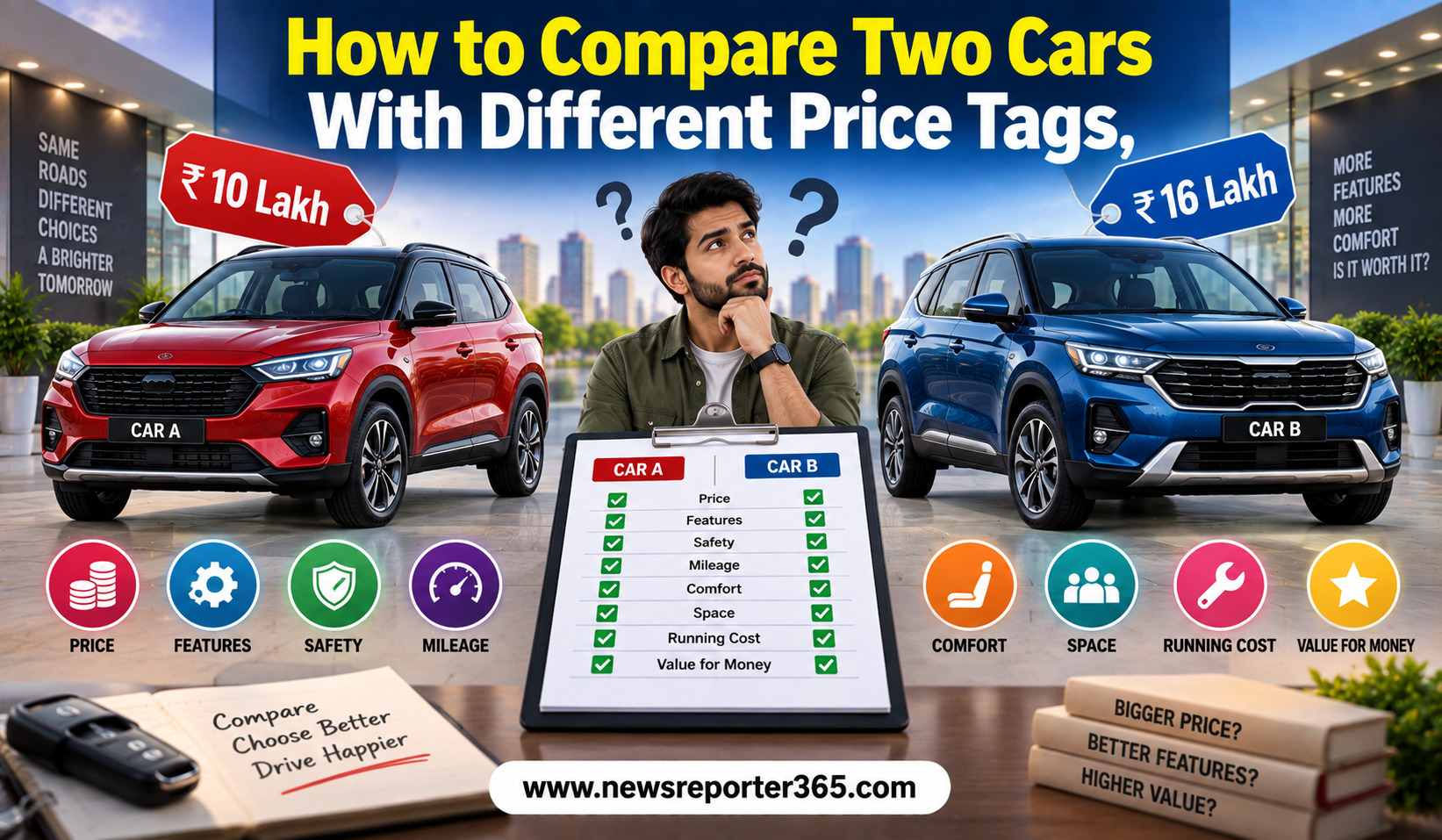
Choosing between two cars is not always as simple as picking the one with the lower price. In today’s market, buyers often compare vehicles that belong to different price brackets but offer overlapping features, sizes or technologies. One car may cost several lakh rupees more than another, yet the cheaper model could provide better value for a particular buyer. At the same time, the more expensive car may justify its price through stronger safety equipment, better performance, improved comfort or lower ownership costs.
This makes a direct price comparison less useful. Instead, buyers need to look at what they receive for the additional money and how each vehicle fits their daily requirements. A structured comparison can reveal whether the extra cost delivers genuine value or simply adds features that may not be important to the buyer.
Start With the Actual Price Difference
The first step is to establish the real difference between the two vehicles. Buyers should compare the same type of price for both cars, preferably the on-road price in the same city.
An ex-showroom comparison can sometimes be misleading because registration charges, road tax, insurance and other expenses can change the final amount. A car that appears only ₹1 lakh more expensive on paper may have a larger difference once both vehicles are ready to drive on public roads.
For example, if Car A has an on-road price of ₹9 lakh and Car B costs ₹11.5 lakh, the real question is not simply whether Car B is worth ₹2.5 lakh more. The buyer should ask what additional benefits that ₹2.5 lakh provides.
This changes the comparison from “Which car is cheaper?” to “What am I getting for the extra money?”
Compare the Same Type of Variant
A common mistake is comparing a base variant of one car with a top variant of another. This can make the feature difference look much larger than it actually is.
The better approach is to identify variants that are reasonably comparable. Buyers should check which safety, comfort, convenience and technology features are available at similar prices.
Sometimes the cheaper car’s higher variant can compete directly with the more expensive car’s lower or mid variant. In other situations, the expensive model may offer equipment that is unavailable on the cheaper car regardless of the variant selected.
This is why the variant level matters almost as much as the model itself.
Look Beyond the Number of Features
Car advertisements often highlight long lists of features. A vehicle may have a larger touchscreen, more speakers, connected-car technology, ambient lighting or additional convenience features. While these can improve the ownership experience, not every feature carries the same value for every buyer.
Safety-related equipment generally deserves more attention than cosmetic or entertainment features. Similarly, buyers who regularly drive in cities may value a good automatic transmission, parking camera and comfortable seating more than high-performance hardware.
The goal is not to choose the car with the longest feature list. It is to identify which features will actually be useful during everyday driving.
Safety Should Be a Major Part of the Comparison
When two cars have different price tags, safety should not be treated as an optional category. Buyers should examine the safety equipment available on the specific variants they are considering.
Important areas include airbags, electronic stability control, braking technology, child-safety provisions and available driver-assistance features. Crash-test performance can also provide useful additional information where reliable testing data is available.
A more expensive car does not automatically guarantee better safety, just as a cheaper vehicle is not automatically unsafe. The comparison should be based on the actual equipment and safety performance of the specific models and variants.
For family buyers, this category can sometimes justify spending more than a feature such as a larger infotainment display or premium upholstery.
Compare Engine, Transmission and Real-World Performance
Price differences can also reflect differences in powertrains. One car may use a naturally aspirated petrol engine, while another may offer a turbocharged engine or a hybrid system. Transmission choices can also vary.
Instead of focusing only on horsepower figures, buyers should consider how the car behaves in the conditions where it will be used. A city commuter may prioritise smooth low-speed performance and easy manoeuvrability, while someone who frequently travels on highways may value stronger acceleration and better high-speed cruising ability.
Fuel efficiency is another important factor. A slightly more expensive car that consumes less fuel over thousands of kilometres could reduce the ownership-cost gap over several years.
Ownership Cost Can Change the Value Equation
The purchase price is only one part of the financial calculation. Insurance, servicing, fuel, tyres, replacement parts and unexpected repairs can influence the long-term cost of owning a vehicle.
A cheaper car may not necessarily remain cheaper if it has significantly higher running expenses. Conversely, an expensive model may become difficult to justify if its maintenance and insurance costs are substantially higher.
Buyers should therefore estimate ownership costs over the period they expect to keep the car. A three-year comparison may produce a different result from a seven-year comparison.
| Comparison Area | Lower-Priced Car | Higher-Priced Car | What Buyers Should Ask |
| Purchase price | Usually lower | Usually higher | What does the extra money provide? |
| Safety | Depends on variant | Depends on variant | Which safety features are standard? |
| Performance | May be adequate | May offer stronger power | Is the extra performance useful? |
| Features | Often fewer | Often more | Which features will I actually use? |
| Fuel efficiency | Model dependent | Model dependent | What is the expected running cost? |
| Maintenance | Can be lower | Can be higher | What are typical service expenses? |
| Resale value | Model dependent | Model dependent | Which has stronger used-car demand? |
Consider Space and Practicality
A more expensive car is not necessarily more practical. Buyers should compare cabin space, boot capacity, seating comfort and storage options according to their daily needs.
For a family, rear-seat comfort may be more important than premium dashboard features. Someone who travels frequently may care more about luggage space, while a city driver may prefer a compact vehicle that is easier to park.
The physical dimensions of the car also matter. A larger vehicle can offer more space but may be less convenient on narrow roads or in crowded parking areas.
Therefore, buyers should consider how the car will actually be used instead of assuming that a larger or more expensive vehicle is automatically better.
Check Which Features Are Truly Worth Paying For
The extra money between two cars can sometimes buy useful equipment, but in other cases it mainly pays for luxury or convenience.
Before choosing the more expensive car, buyers should divide additional features into three broad categories:
- Features that improve safety
- Features that make everyday driving easier
- Features that are mainly cosmetic or entertainment-focused
This simple exercise can make the decision clearer. If most of the additional money is paying for features the buyer does not care about, the cheaper car may offer better value.
However, if the price difference brings significant improvements in safety, comfort or powertrain technology, spending more may make sense.
Don’t Ignore Financing Costs
The price gap becomes particularly important when both vehicles are financed. A ₹2 lakh or ₹3 lakh difference in purchase price can become a larger financial commitment once interest is included.
Buyers should compare the down payment, loan amount, interest rate, tenure and total repayment amount rather than looking only at the monthly EMI.
A longer loan tenure can make an expensive car appear affordable because the monthly payment is smaller, but the total interest paid may be higher. Buyers should make sure the vehicle remains comfortable within their overall monthly budget.
Take a Test Drive Before Making the Final Decision
Specifications can narrow down the choices, but a test drive can reveal differences that numbers cannot fully explain.
Driving both cars on similar roads allows buyers to compare seating position, visibility, steering response, suspension comfort, braking feel, cabin noise and transmission behaviour.
It is particularly important to drive the cars in conditions that resemble normal usage. Someone who mainly drives in traffic should pay attention to low-speed comfort and ease of operation rather than testing only acceleration on an open road.
A second test drive with family members can also be useful when rear-seat comfort and practicality are important factors.
Think About Resale Value
Resale value is another factor that can change the overall cost equation. Some cars retain their value better because of brand reputation, reliability perception, strong demand or lower ownership costs.
This does not mean buyers should select a car purely based on resale value. However, someone who plans to replace the vehicle after three or four years should consider how much value each model may retain.
The effective cost of ownership can be understood more clearly by considering the purchase price and likely resale value together.
Make the Final Decision Based on Value, Not Price
The most expensive car is not always the best car, and the cheapest one is not always the best bargain. The right choice depends on the balance between price, features, safety, comfort, performance and ownership expenses.
A useful final comparison should answer a few practical questions. Does the cheaper car meet all essential requirements? Does the expensive car provide improvements that will actually be noticed every day? Can the buyer comfortably afford the additional purchase and ownership costs? And will those additional benefits remain useful for several years?
If the answers point toward the cheaper model, there is little reason to spend more simply for a higher badge or longer feature list. If the more expensive car offers meaningful improvements in areas that matter, the extra investment may be justified.
Final Word
Comparing two cars with different price tags requires more than looking at their showroom prices. The better approach is to compare their real on-road costs and then examine what each vehicle offers in return.
Safety, powertrain performance, comfort, practicality, fuel economy, maintenance, financing and resale value can all influence the actual value of a car. Most importantly, buyers should focus on their own driving requirements instead of assuming that a higher price automatically means a better purchase.
A smart car purchase is not necessarily the one with the lowest price or the most features. It is the vehicle that delivers the right combination of usefulness, affordability and long-term value.
FAQs
Should I always choose the cheaper car?
No. The cheaper car may offer better value, but the more expensive model could provide important improvements in safety, comfort, performance or technology. The decision should depend on what you actually need.
How should I compare two cars with different prices?
Start by comparing their on-road prices for the same city. Then compare safety, engine and transmission, features, space, fuel efficiency, maintenance, financing and expected resale value.
Is the higher-priced car always better?
No. Price does not automatically determine overall value. A cheaper car can be a better choice if it meets the buyer’s requirements without unnecessary additional spending.
Should safety matter more than luxury features?
For most buyers, safety should be a higher priority than cosmetic or entertainment features. The exact safety equipment of the variants being compared should be checked before making a decision.
Is fuel efficiency important when comparing cars?
Yes. Fuel or charging costs accumulate throughout ownership. A vehicle with better efficiency can potentially reduce the long-term cost difference between two cars.
Should I compare the base variants of two cars?
Not necessarily. It is usually more useful to compare variants that offer similar equipment and fall within a realistic budget range. Base-versus-top-variant comparisons can produce misleading conclusions.