

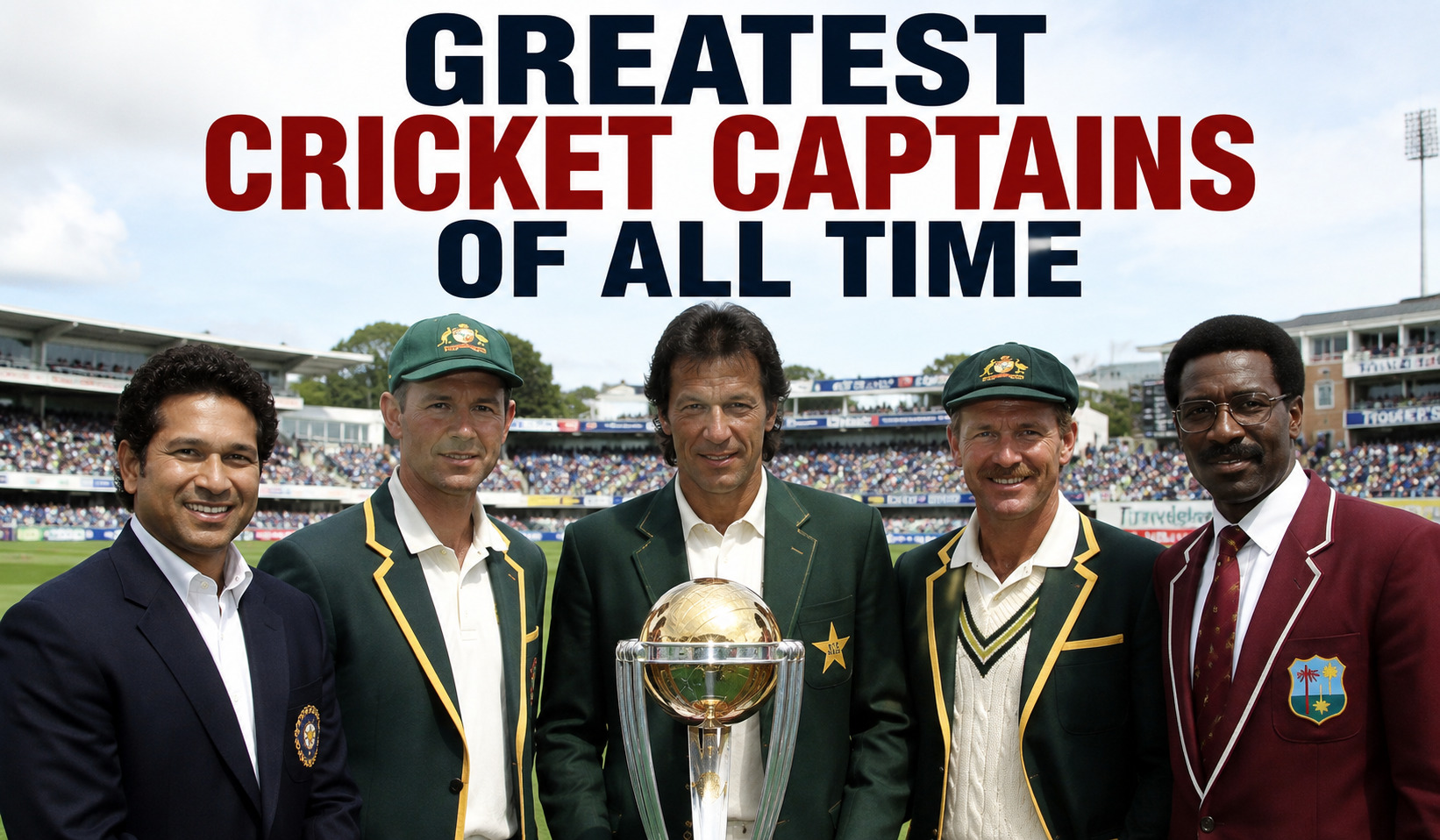
Cricket has produced countless talented players, but only a select few have truly transformed their teams through leadership. A great captain is measured by more than just the trophies they win. when to attack, when to defend, how to manage pressure and how to bring the best out of players around them.
Throughout cricket’s history, the game has been shaped by captains with distinct personalities, leadership philosophies, and approaches to handling pressure. Some relied on tactical innovation, others on discipline and preparation, while a few inspired their teams through sheer confidence and determination. Their methods may have differed, but their influence on the game remains unmistakable.
From Test cricket pioneers to modern limited-overs leaders, several captains have left a lasting mark on international cricket. Comparing them across generations is never completely straightforward because the game has changed dramatically. Formats, playing conditions, technology, schedules and professional structures are all very different today.
Still, some leadership achievements stand above the rest. Captains such as Clive Lloyd, Steve Waugh, Ricky Ponting, MS Dhoni, Graeme Smith, Stephen Fleming and Imran Khan are frequently discussed whenever cricket’s greatest leaders are mentioned.
What Makes a Great Cricket Captain?
Captaincy is one of the most demanding roles in professional sport. A captain has to make decisions within seconds while also managing players with different personalities, strengths and expectations.
The strongest captains generally combine several qualities:
- Tactical awareness and the ability to read a match.
- Strong communication and player management.
- The confidence to make difficult decisions under pressure.
- The ability to remain calm when a match moves against the team.
However, leadership cannot be measured by statistics alone. A captain can have an impressive win percentage but leave little long-term influence, while another may lead a struggling team through a difficult rebuilding period and create the foundation for future success.
That is why the greatest captains should be judged through a combination of results, tactical influence, team culture and historical impact.
Clive Lloyd: The Captain Who Built a Cricket Dynasty
Clive Lloyd occupies a special place in cricket history because he led one of the most dominant teams ever assembled.
As captain of the West Indies, Lloyd helped create a side that became almost impossible to beat during the late 1970s and 1980s. His leadership was supported by a remarkable group of fast bowlers and talented batsmen, but managing such a powerful squad still required considerable skill.
Lloyd’s West Indies won the first two Cricket World Cups, in 1975 and 1979. Their success was not based on one outstanding tournament. They established a culture of dominance that extended across formats.
His captaincy was closely associated with aggressive fast bowling. The West Indies developed a formidable pace attack capable of intimidating opposition batsmen while also maintaining relentless accuracy.
Lloyd’s own presence added authority to the team. He was a powerful middle-order batsman, but his greatest contribution was creating a winning mentality that became part of West Indies cricket’s identity.
His era remains one of the clearest examples of how a captain can help turn a collection of talented players into a sporting dynasty.
Imran Khan: Leadership That Transformed Pakistan
Imran Khan’s captaincy is remembered not only because of Pakistan’s 1992 World Cup victory but also because of the broader influence he had on Pakistani cricket.
Pakistan entered the 1992 tournament without being considered the strongest favourite. Their campaign appeared to be in serious trouble during the group stage, but the team recovered and progressed through the knockout rounds.
In the final at Melbourne, Pakistan defeated England to win their first World Cup.
Imran’s leadership style combined confidence, discipline and an ability to encourage players to believe they could compete with the strongest teams. His own performances also gave the team credibility. He was capable of influencing matches with both bat and ball while carrying the responsibility of captaincy.
Perhaps the most important aspect of his legacy was the belief he created within the team. Pakistan’s victory became one of the most celebrated moments in the country’s cricket history.
Imran demonstrated that captaincy is sometimes about convincing players that a difficult situation can still be turned around.
Steve Waugh: The Leader of Australia’s Winning Culture
Under Waugh, Australia developed a reputation for refusing to accept defeat. His team was filled with world-class players, but Waugh’s contribution was creating a culture in which winning became an expectation rather than an occasional achievement.
Australia’s Test dominance during his captaincy established them as the benchmark for other teams. Waugh was also captain when Australia won the 1999 World Cup, although Ricky Ponting played a major role in Australia’s later World Cup success.
Waugh’s personal style was generally calm rather than theatrical. He was comfortable allowing his cricket to communicate his leadership.
His famous emphasis on mental toughness influenced how an entire generation viewed Test cricket. Australia under Waugh did not simply try to win matches; they aimed to control them.
Ricky Ponting: Australia at Its Peak
Ricky Ponting inherited an exceptionally strong Australian team and took it to another level.
As captain, Ponting led Australia to World Cup victories in 2003 and 2007. The 2003 campaign was particularly memorable because Australia went through the tournament unbeaten, while the 2007 team maintained its dominance on the world stage.
Ponting’s captaincy was more aggressive than Waugh’s in certain respects. He was willing to attack with field placements and make bold bowling changes. His confidence was visible, and his teams often played with a clear sense of authority.
His leadership record was strengthened by his own batting. Ponting was among the world’s leading batsmen during his captaincy, meaning opposition teams had to deal with both his tactical decisions and his ability to score heavily.
The combination of tactical confidence and personal performance makes Ponting one of the strongest candidates when discussing the greatest captains of the modern era.
MS Dhoni: The Captain Who Mastered Pressure
MS Dhoni’s captaincy transformed India’s position in world cricket.
His leadership career became historic because he won major ICC trophies across different formats. India won the inaugural ICC World Twenty20 in 2007 under Dhoni, followed by the 2011 ODI World Cup and the 2013 Champions Trophy.
The 2011 World Cup remains particularly important. Playing in front of a home crowd, India defeated Sri Lanka in the final in Mumbai, with Dhoni finishing the chase himself with a memorable six.
Dhoni’s captaincy was defined by calm decision-making. He rarely appeared overwhelmed by pressure, even when matches reached their most difficult stages.
He also trusted players in important situations. His willingness to give young or developing players significant responsibilities helped create a team capable of competing across formats.
Dhoni’s influence extended beyond trophies. He helped establish a leadership culture in which players were encouraged to remain composed and focus on the immediate situation rather than the pressure surrounding it
Graeme Smith: The Young Captain Who Rebuilt South Africa
Graeme Smith’s captaincy was remarkable because of how young he was when he received the responsibility.
Smith took over as South Africa’s Test captain at just 22, stepping into a demanding role at an exceptionally young age. Leading an international side so early in his career required remarkable maturity, confidence, and composure.
His leadership became central to South Africa’s development into one of the strongest Test sides of the 2000s and early 2010s.
Smith was not always the most tactically spectacular captain, but his strength came from durability, confidence and an ability to stand in difficult situations.
His tenure demonstrated that great captaincy is not necessarily about dramatic decisions. Sometimes it is about providing stability over a long period.
Smith stands among the most successful Test captains statistically and remains one of the most influential leaders in South African cricket history.
Stephen Fleming: The Quiet Tactical Mastermind
Stephen Fleming led New Zealand during an era when the team often competed against nations with greater resources and deeper squads.
His leadership style was different from the more aggressive personalities associated with Australia or Pakistan. Fleming was calm, analytical and tactically flexible.
He understood how to maximise limited resources and frequently developed strategies specifically designed around his players’ strengths.
Although New Zealand did not win the major ICC trophies during his international captaincy, Fleming’s leadership helped establish the team’s reputation for competitive, intelligent cricket.
His later success as a coach in franchise cricket further reinforced his reputation as a strategic thinker.
Fleming is an important reminder that captaincy cannot be judged solely by trophy counts. Leadership can also be measured by how effectively a captain helps a team compete beyond its perceived limitations.
Virat Kohli: A New Era of Test Intensity
Virat Kohli brought a different energy to India’s Test captaincy.
His leadership was closely associated with fitness, aggression and a strong emphasis on fast bowling. During his tenure, India became increasingly competitive overseas, something that had historically been a major challenge for the team.
Kohli demanded high standards from himself and his teammates. His aggressive personality became part of India’s identity, particularly in Test cricket.
One of the biggest developments during his captaincy was India’s fast-bowling depth. Players such as Jasprit Bumrah, Mohammed Shami and Ishant Sharma became central to India’s success in overseas conditions.
Kohli’s captaincy therefore represented more than a collection of wins. It helped change expectations around Indian Test cricket.
Comparing Some of Cricket’s Greatest Captains
Because these captains played in different eras and formats, direct comparisons are difficult. However, their major leadership achievements provide useful context.
| Captain | Country | Major Leadership Achievement | Defining Quality |
| Clive Lloyd | West Indies | Two World Cup titles | Building dominance |
| Imran Khan | Pakistan | 1992 World Cup | Inspiration |
| Steve Waugh | Australia | 1999 World Cup and Test dominance | Mental toughness |
| Ricky Ponting | Australia | 2003 & 2007 World Cups | Aggression |
| MS Dhoni | India | T20 WC, ODI WC & Champions Trophy | Calmness |
| Graeme Smith | South Africa | Long-term Test success | Resilience |
| Stephen Fleming | New Zealand | Competitive team-building | Tactical intelligence |
| Virat Kohli | India | Test transformation | Intensity & fitness |
The table highlights an important point: there is no single formula for successful captaincy.
The Evolution of Cricket Captaincy
Captaincy has changed considerably over the years. Earlier generations often relied heavily on instinct and experience. Modern captains have access to extensive data, video analysis and performance metrics.
Technology has also changed decision-making. Captains can now review ball-by-ball information, analyse opposition weaknesses and receive detailed tactical information from coaching teams.
Yet the fundamentals remain similar.
A captain still has to understand the personalities in the dressing room, identify when a player needs support and make decisions when there is no perfect answer.
The rise of T20 cricket has made captaincy even more complicated. Captains may have only a few deliveries to make a tactical decision, and bowling changes or field placements can have an immediate impact.
Modern leadership therefore requires both analytical thinking and instinct.
What Separates the Greatest Captains?
The captains most frequently remembered as all-time greats tend to share a few important characteristics. They understand the strengths of their players, accept responsibility when things go wrong and remain confident when pressure is at its highest.
More importantly, they create teams that continue to perform even when individual stars are unavailable.
The greatest captains usually have the ability to:
- Build a strong team culture.
- Adapt tactics to different opponents and conditions.
- Develop younger players into reliable performers.
- Perform under pressure while carrying leadership responsibilities.
Trophies remain important, but lasting influence is equally significant.
Captaincy Beyond the Trophy Cabinet
It is tempting to rank captains purely by the number of trophies they won. However, that approach can be misleading.
A captain who inherits one of the strongest teams in cricket history begins with different advantages from a leader who takes over a rebuilding side.
Similarly, different formats require different skills. A successful T20 captain may not necessarily be the best Test captain, while a Test specialist may struggle with the speed of limited-overs decision-making.
This is why names such as Fleming and Smith deserve consideration alongside World Cup-winning captains. Their leadership helped shape teams even when major tournament trophies were not always available.
The greatest captains leave behind something more valuable than statistics: a team identity.
The Lasting Legacy of Cricket’s Great Leaders
Cricket’s greatest captains are remembered because their leadership became part of the sport’s history.
Clive Lloyd created a West Indies powerhouse. Imran Khan inspired Pakistan to an unlikely World Cup victory. Steve Waugh and Ricky Ponting led Australia through one of its most dominant eras.
MS Dhoni showed India how calm leadership could produce success across formats, while Graeme Smith provided South Africa with stability during a crucial period. Stephen Fleming demonstrated the importance of tactical intelligence, and Virat Kohli helped reshape India’s approach to Test cricket.
Each captain left a different legacy.
That diversity is what makes cricket captaincy so fascinating. There is no single personality type that guarantees success. Some leaders inspire through emotion, others through discipline, calmness, aggression or tactical intelligence.
Conclusion
The greatest cricket captains of all time cannot be selected through one statistic or one trophy. Their careers need to be understood within the context of their teams, eras and challenges.
Clive Lloyd, Imran Khan, Steve Waugh, Ricky Ponting, MS Dhoni, Graeme Smith, Stephen Fleming and Virat Kohli each demonstrated different forms of leadership. Some built dominant teams, others transformed struggling sides, while several created lasting changes in cricket culture.
Their greatest achievement was not simply winning matches. It was creating belief.
A captain can make tactical decisions, set fields and choose bowlers, but the most influential leaders do something deeper. They convince players that they belong at the highest level and give them the confidence to perform when the pressure is greatest.
That is why the debate over cricket’s greatest captain will never have one definitive answer. Different generations will always favour different leaders. Yet the captains who changed how their teams played, competed and believed will continue to occupy a special place in cricket history.
FAQs
Who is considered the greatest cricket captain of all time?
There is no universally accepted answer. Clive Lloyd, Steve Waugh, Ricky Ponting, MS Dhoni and Imran Khan are among the most frequently mentioned because of their major tournament victories and influence on their teams.
Who is the most successful captain in World Cup cricket?
Several captains have outstanding World Cup records. Clive Lloyd won the first two Men’s Cricket World Cups in 1975 and 1979, while Ricky Ponting led Australia to consecutive titles in 2003 and 2007. .
Why is MS Dhoni considered one of cricket’s greatest captains?
Dhoni is one of the few captains to win all three major men’s ICC limited-overs trophies: the 2007 T20 World Cup, 2011 ODI World Cup and 2013 Champions Trophy. His calm approach under pressure also became a defining feature of his leadership.
What made Imran Khan a great captain?
Imran Khan combined personal performance with inspirational leadership. His greatest achievement came in 1992 when he led Pakistan to its first Cricket World Cup title after the team had struggled early in the tournament.