

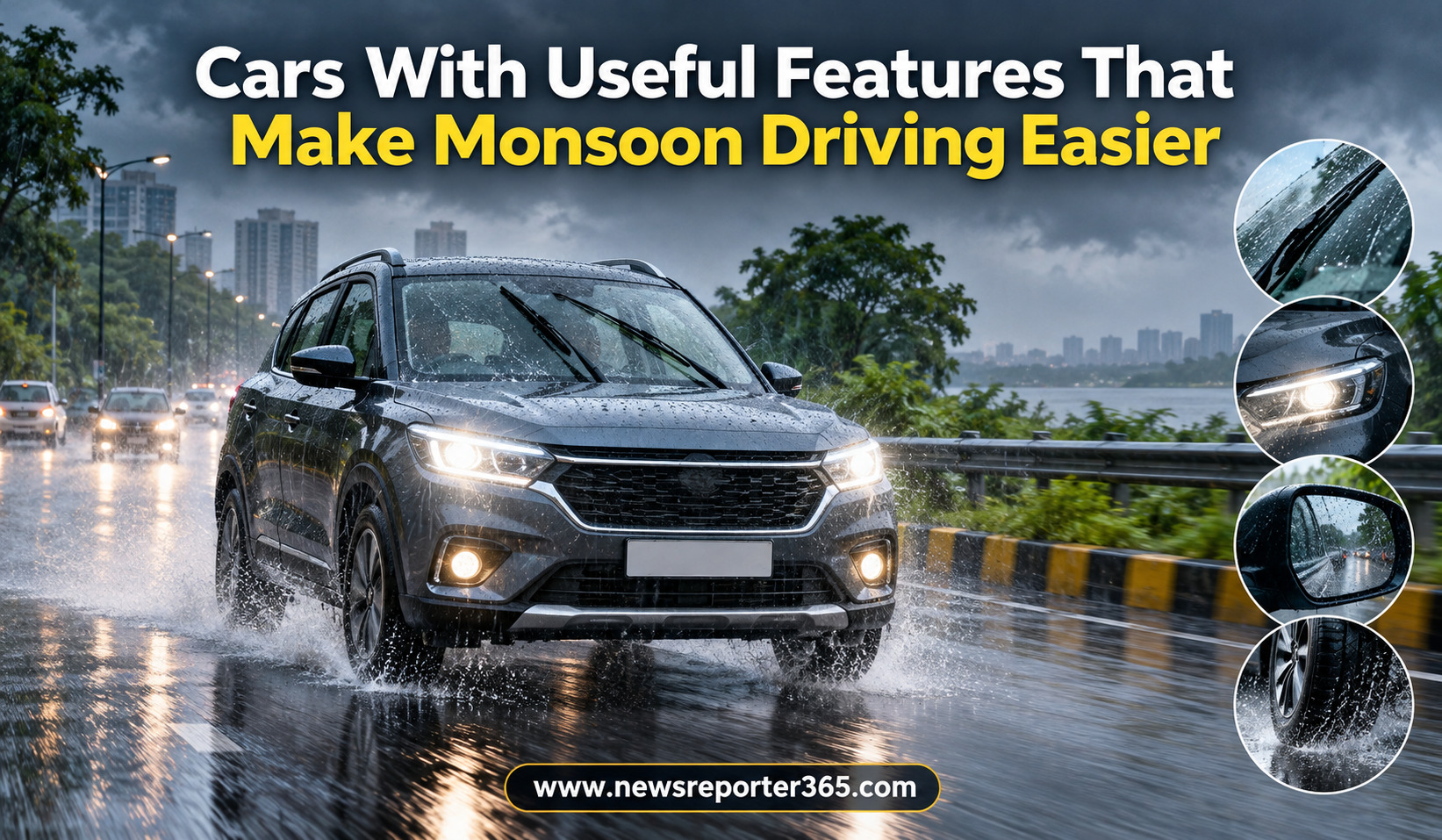
Monsoon driving can be challenging even for experienced motorists. Heavy rain can reduce visibility, wet roads can affect braking and grip, and waterlogged streets can make familiar routes difficult to navigate. In these conditions, the features fitted to a car can make everyday driving more comfortable and, in some situations, safer.
Modern cars increasingly come with technologies designed to assist drivers during difficult weather. Some features directly improve visibility, while others help maintain vehicle control or make it easier to deal with wet and slippery roads. However, no feature can replace careful driving, proper tyres and sensible speed during heavy rainfall.
For buyers who live in areas that experience significant monsoon conditions, these features are worth considering when selecting an everyday car.
Why Monsoon-Friendly Features Matter
Rain changes the driving environment quickly. Water on the road can hide potholes, road markings may become difficult to see and vehicles around you can create additional spray. During particularly heavy showers, even a short journey can become more demanding.
A car equipped with useful visibility and safety features can reduce some of these difficulties. Automatic climate control, effective windshield defogging, rain-sensing wipers, electronic stability control and good lighting are examples of equipment that can improve the driving experience.
The most useful features are not necessarily the most expensive ones. In fact, several practical features available on mainstream cars can be more valuable during the monsoon than cosmetic equipment.
Rain-Sensing Wipers Help Maintain Visibility
Windshield wipers are among the simplest but most important features during rain. Rain-sensing wipers take this idea further by automatically adjusting wiping speed according to the amount of water detected on the windshield.
This can reduce the need for the driver to repeatedly adjust the wiper controls while concentrating on the road. During light rain, the system can operate at a slower speed, while heavier rainfall can trigger faster wiping.
Not every rain-sensing system works identically, and drivers should still be prepared to control the wipers manually when necessary. Nevertheless, it can be a convenient feature during changing weather conditions.
Automatic Climate Control and Defogging
One of the most common monsoon problems is windshield fogging. Humidity, wet clothing and differences between interior and exterior temperatures can cause condensation to appear on the glass.
A good climate-control system can make it easier to maintain a clear windshield. Cars with dedicated front and rear defogging functions can be particularly useful when visibility becomes compromised.
Automatic climate control can also help maintain a consistent cabin temperature, reducing the need for frequent manual adjustments during a journey.
For families and daily commuters, this feature may prove more useful than several entertainment-focused features because clear visibility is directly connected to driving confidence.
Electronic Stability Control Adds an Extra Safety Layer
Electronic Stability Control, commonly known as ESC, is an important safety technology for modern vehicles. The system can help the driver maintain control when the car begins to deviate from the intended path.
Wet roads can reduce available grip, particularly when a vehicle makes a sudden steering or braking manoeuvre. ESC can detect differences between the driver’s steering input and the vehicle’s movement and intervene when necessary.
ESC is not a substitute for responsible driving. Excessive speed on a wet road can still result in loss of control. However, it provides an additional electronic safety layer and is an important feature to consider when purchasing a new car.
ABS Helps During Emergency Braking
Anti-lock Braking System, or ABS, is another important feature during monsoon driving. Wet surfaces can reduce tyre grip, increasing the challenge of stopping quickly.
ABS helps prevent the wheels from locking during hard braking, allowing the driver to maintain steering control while braking. Most modern passenger cars are equipped with ABS, but buyers should still understand its importance when comparing older or used vehicles.
ABS works together with the tyres and braking system. Worn tyres or poor road conditions can still significantly increase stopping distances.
Tyres Remain More Important Than Many Electronic Features
Even the most advanced car cannot compensate for severely worn or incorrectly inflated tyres. Tyres are the only parts of the vehicle that directly contact the road, making their condition particularly important during rainfall.
Adequate tread depth helps tires move water away from the contact patch. Correct tyre pressure is equally important because both underinflation and overinflation can affect handling and braking.
Drivers should inspect tyres before and during the monsoon season, especially if the vehicle is frequently used for long journeys.
Ground Clearance Can Help on Waterlogged Roads
Ground clearance can be useful when driving through roads with standing water or uneven surfaces. A vehicle with sufficient clearance provides more space between the road and its lower components.
However, high ground clearance does not mean a car can safely drive through any depth of water. Deep water can enter the engine, electrical components or cabin and cause serious damage.
Drivers should avoid flooded roads whenever the depth is uncertain. If water has already risen significantly, turning around may be safer than attempting to cross it.
Rear Cameras and Parking Sensors Improve Low-Visibility Manoeuvres
Heavy rain can make parking and reversing more difficult. Water droplets on windows and mirrors, poor lighting and reflections from wet surfaces can reduce visibility around the vehicle.
A rear-view camera can provide a clearer view behind the car, while parking sensors can alert the driver to nearby obstacles. These features are especially useful in crowded parking areas, where visibility may already be limited.
However, camera lenses can become covered with water or dirt. Drivers should keep cameras and sensors clean to ensure they work as intended.
LED Lighting Can Improve Night-Time Visibility
Rainy conditions become more difficult after sunset because road surfaces reflect headlights and visibility can fall sharply. Effective headlights and tail lamps are therefore important during the monsoon.
Modern cars may use LED headlights, LED daytime running lights and LED tail lamps. While lighting technology can improve visibility, drivers should use the appropriate beam and avoid dazzling other road users.
Headlight alignment also matters. Incorrectly adjusted lights can reduce visibility or create glare for approaching drivers.
Useful Monsoon Features at a Glance
| Feature | How it helps during monsoon | Importance |
| Rain-sensing wipers | Adjust wiping according to rainfall | High |
| Front/rear defogger | Helps maintain clear glass | High |
| Automatic climate control | Controls cabin temperature and humidity | High |
| ESC | Helps maintain vehicle stability | Very High |
| ABS | Helps maintain steering control during hard braking | Very High |
| Rear camera | Improves rear visibility | Useful |
| Parking sensors | Helps detect nearby obstacles | Useful |
| Adequate ground clearance | Provides additional underbody clearance | Useful |
| Good headlights | Helps improve visibility in rain and darkness | High |
Features That Make Everyday Monsoon Driving More Comfortable
Safety systems are important, but several convenience features can also make rainy-day driving less stressful. Keyless entry can reduce the need to handle keys while getting into the vehicle during rain. Automatic headlights can help when dark clouds suddenly reduce daylight.
A heated or electrically adjustable outside mirror, where available, can also help maintain visibility in difficult conditions. A spacious cabin with easy-to-clean upholstery can be beneficial for families because wet footwear, umbrellas and raincoats often bring additional moisture and dirt into the vehicle.
These features may seem minor individually, but they can improve the ownership experience during several months of wet weather.
Four Features Buyers Should Prioritise
When choosing a car specifically for monsoon-friendly everyday use, buyers should focus on practical equipment rather than simply selecting the longest feature list:
- Strong visibility support: Rain-sensing wipers, defoggers and effective lighting can help the driver maintain a clear view.
- Essential electronic safety: ABS and ESC should be high on the priority list because wet roads can reduce available grip.
- Good tyres: The vehicle should be equipped with quality tyres that have appropriate tread and correct specifications.
- Useful parking assistance: Rear cameras and parking sensors can make manoeuvring easier when visibility is poor.
SUVs Are Not Automatically Better in Heavy Rain
SUVs are often considered ideal for monsoon driving because many have higher ground clearance. This can be useful on uneven or damaged roads, but it does not automatically make an SUV safer in every rainy condition.
A well-equipped hatchback or sedan with good tyres, ABS, ESC and effective visibility systems can also be very capable in wet weather. Vehicle weight, tyre quality, braking performance and driver behaviour all matter.
The decision should therefore be based on the roads the vehicle will actually encounter rather than choosing a larger vehicle simply because it has a higher stance.
Driving Behaviour Still Matters Most
Technology can assist the driver, but safe monsoon driving begins with reducing speed and increasing following distance. Wet roads generally require more time to stop, while standing water can create unexpected hazards.
Drivers should avoid sudden acceleration, sharp steering inputs and unnecessary overtaking during heavy rain. If visibility becomes extremely poor, finding a safe location to stop can be better than continuing simply to reach the destination quickly.
Regular maintenance is equally important. Wipers, brakes, tyres, headlights, battery, windshield washer fluid and air-conditioning systems should all be checked before the monsoon season becomes intense.
Conclusion
Modern cars offer a growing number of features that can make monsoon driving easier. Rain-sensing wipers, defoggers, automatic climate control, ABS, ESC, rear cameras, parking sensors and effective lighting can all contribute to a more comfortable and controlled driving experience.
However, buyers should remember that technology is only one part of monsoon preparedness. Tyre condition, brakes, visibility and suspension maintenance are equally important. Even a car with advanced safety systems can become difficult to control if it is driven too quickly on a flooded or slippery road.
For everyday buyers, the best monsoon-friendly car is therefore not necessarily the one with the most features. A vehicle with strong basic safety equipment, good tyres, useful visibility systems and suitable ground clearance can provide a more practical balance for wet-weather driving.
FAQs
Which car feature is most useful during heavy rain?
There is no single feature that solves every monsoon challenge. ABS, ESC, effective wipers, defoggers, good headlights and quality tyres all play important roles.
Is high ground clearance important during the monsoon?
It can be useful on uneven roads and speed breakers, but ground clearance does not make a vehicle safe for driving through deep floodwater.
Are rain-sensing wipers worth having?
They can be convenient because they automatically adjust wiping speed as rainfall changes, allowing the driver to focus more on the road.
Does ABS work better on wet roads?
ABS helps prevent wheel lock during hard braking and can help the driver retain steering control. However, wet roads can still increase stopping distances.
Is ESC important for monsoon driving?
Yes. ESC can provide an additional layer of control when the vehicle begins to lose stability, particularly during sudden manoeuvres on slippery surfaces.