

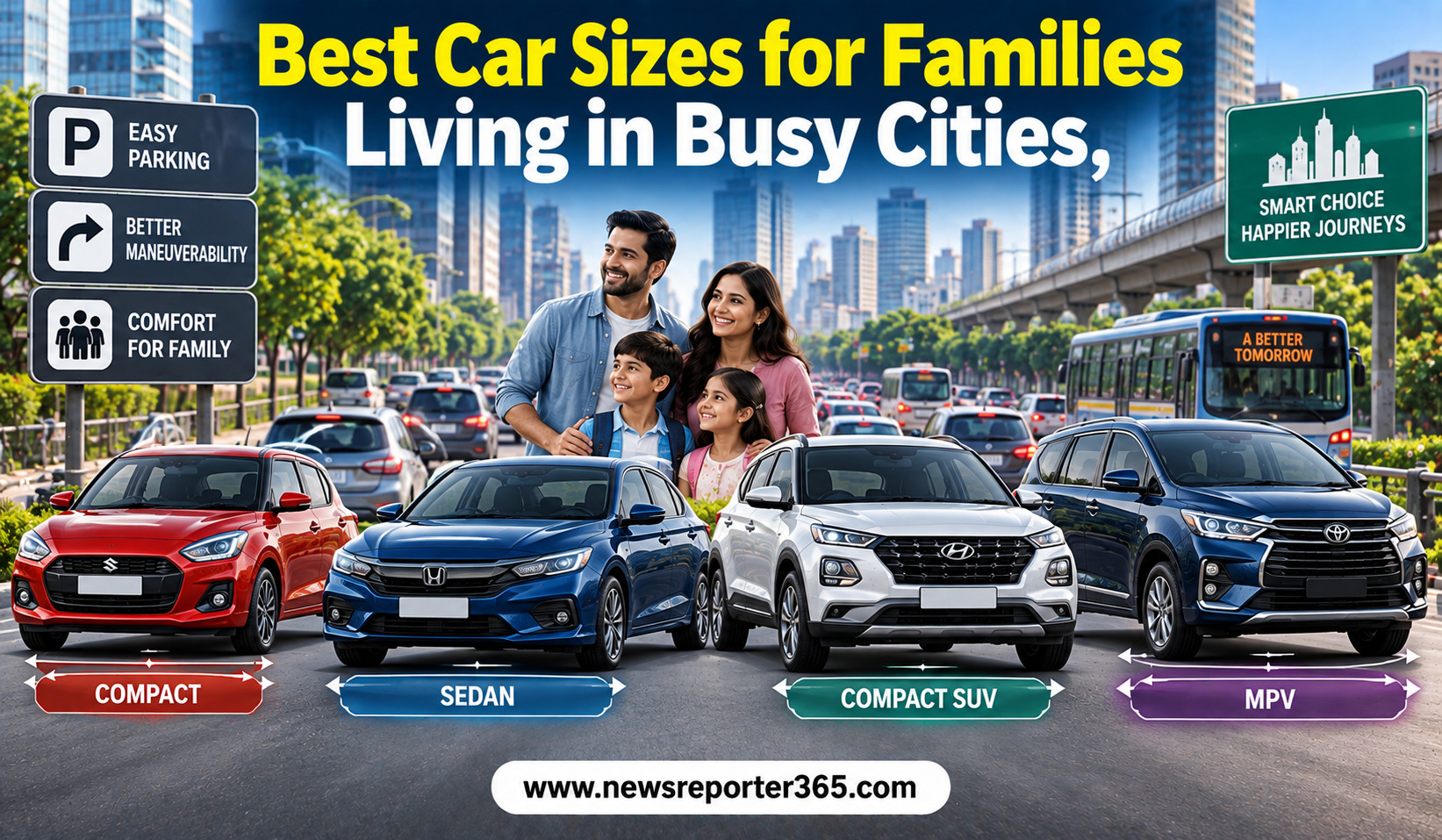
Choosing a family car for a busy city is very different from choosing a vehicle for open highways or long-distance travel. Urban families have to deal with crowded roads, narrow lanes, limited parking spaces, frequent traffic jams and unpredictable road conditions. In such an environment, the physical size of a car can have a major impact on everyday convenience.
For families, however, choosing the smallest possible car is not always the right answer. Parents may need comfortable rear seats, enough boot space for shopping and luggage, room for child seats and easy access for elderly family members. This creates a balance between compact dimensions and practical interior space.
The growing popularity of compact SUVs and crossover vehicles has made the decision even more interesting. Buyers now have several options between traditional hatchbacks and large SUVs. Understanding which size works best for a particular family can help avoid unnecessary compromises after purchase.
Why Car Size Matters in Busy Cities
City roads can be challenging for even experienced drivers. Traffic may leave little room between vehicles, while residential streets can become extremely narrow because of parked cars. Finding a suitable parking space can also be difficult, particularly in older neighbourhoods and crowded commercial areas.
A smaller vehicle generally has an advantage in these situations. It can be easier to manoeuvre through tight roads and may require less space when parking. However, a compact exterior does not necessarily guarantee a comfortable cabin.
Family buyers need to think about both the outside dimensions and the usable space inside. A vehicle should be easy to handle without making regular passengers uncomfortable.
Small Hatchbacks for Compact Families
Small hatchbacks remain one of the most practical choices for families living in congested urban areas. Their relatively compact dimensions make them convenient for daily commuting, shopping trips and navigating narrow roads.
For a couple or a small family that does not regularly carry five adults, a hatchback can offer enough passenger space while keeping parking relatively simple. Fuel efficiency and lower running costs can also make smaller cars attractive to buyers who spend a significant amount of time in traffic.
The main limitation is space. Families with young children may need room for child seats, bags and other equipment, while adults sitting in the rear may want additional legroom.
For buyers whose priority is easy city mobility rather than maximum cabin space, a small hatchback can still be a sensible choice.
Premium Hatchbacks Offer a Middle Ground
Premium hatchbacks provide another option for families who want compact dimensions without moving into a larger SUV. They typically offer more cabin room and equipment than the smallest city cars while remaining relatively easy to drive in crowded areas.
Their larger footprint can provide better rear-seat comfort and additional luggage capacity. At the same time, they generally remain more manageable than many larger SUVs in tight parking areas.
This category can work well for families that use their vehicle primarily in the city but occasionally take longer journeys. However, buyers should compare the exact dimensions of individual models because the differences in width and turning radius can affect urban usability.
Compact SUVs for Growing Families
Compact SUVs have become increasingly popular among urban families because they attempt to combine a higher driving position with manageable dimensions.
The higher seating position can make entering and exiting the vehicle easier for some passengers. Families may also appreciate the additional cabin height and flexible luggage space.
However, not every compact SUV is equally city-friendly. Some models can be significantly wider or longer than hatchbacks, making a noticeable difference in tight streets and parking spaces.
For families with children, frequent passengers or more luggage requirements, a compact SUV can offer a useful compromise between practicality and urban manoeuvrability.
Are Sedans Still Practical for City Families?
Sedans can be excellent family cars, particularly for buyers who value rear-seat comfort and a separate luggage compartment. Their longer wheelbase in some models can provide generous passenger space.
The challenge comes mainly from the rear section of the vehicle. The longer boot can make parking more difficult in tight spaces, particularly for drivers who are not comfortable judging the car’s rear corners.
Parking cameras and sensors can reduce some of these difficulties, but they do not change the vehicle’s physical footprint.
Families who have dedicated parking and regularly travel on highways may find a sedan highly practical, even if it is not the easiest option for extremely congested streets.
Midsize SUVs: More Space, More Compromise
Midsize SUVs can provide substantial cabin and luggage space and may be attractive to larger families. They can also be useful for buyers who regularly travel outside the city.
However, their larger dimensions can become a disadvantage in heavily congested urban areas. Narrow roads, underground parking ramps and small parking slots can be more demanding.
A midsize SUV makes more sense when the additional space is genuinely required. Buying one simply because it appears more spacious can lead to unnecessary compromises during daily city use.
For a family of four that mostly travels within a dense urban environment, a smaller vehicle may actually be more convenient.
Comparing Car Sizes for Urban Families
| Car Type | City Manoeuvrability | Family Space | Parking Convenience | Suitable For |
| Small Hatchback | Excellent | Moderate | Excellent | Couples and small families |
| Premium Hatchback | Very Good | Good | Very Good | Small to medium families |
| Compact SUV | Good | Very Good | Good | Growing families |
| Sedan | Moderate | Good to Very Good | Moderate | Families with highway use |
| Midsize SUV | Moderate | Excellent | Moderate to Difficult | Larger families and frequent travel |
These are general comparisons. The actual experience depends on the dimensions, turning radius, visibility and interior layout of each individual model.
Rear-Seat Space Is Critical for Families
Families should not judge a vehicle purely by its exterior dimensions. Rear-seat usability can be more important than the overall length of the car.
Parents travelling with young children may need to install child seats, while families with older children may want sufficient legroom for longer journeys. If three people regularly sit in the rear, shoulder room becomes another important consideration.
During a showroom visit, families should actually sit in the second row rather than simply looking at the specifications. Check whether passengers can sit comfortably with the front seats adjusted for the driver and front passenger.
This practical test can reveal differences that are difficult to understand from a brochure.
Don’t Forget the Boot
Urban families may use their car for much more than commuting. Grocery shopping, school bags, weekend luggage, sports equipment and other household items can quickly fill a small boot.
A hatchback with a flexible rear seat may be more useful than a sedan with a larger quoted boot capacity if the family frequently carries bulky objects.
Families should therefore inspect the boot opening, floor height and usable shape rather than focusing only on the published capacity.
For regular family travel, practical luggage space can be more valuable than simply having a large numerical capacity.
Parking Space Should Influence Your Choice
Before buying a larger family car, owners should consider where it will be parked every day. Apartment parking spaces can be narrow, and some buildings have difficult ramps or pillars close to designated slots.
A vehicle that technically fits into a parking space may still be inconvenient if there is insufficient room to open the doors or manoeuvre into the slot.
Buyers should measure their regular parking area and compare it with the vehicle’s width and length. This is particularly important when moving from a hatchback to an SUV.
Parking sensors, rear cameras and 360-degree camera systems can be useful, but they should be viewed as assistance rather than a solution to inadequate physical space.
Turning Radius and Visibility Matter
Two vehicles with similar dimensions can feel completely different in city traffic. Turning radius, steering response and outward visibility can influence how easy the vehicle is to position.
A smaller turning circle can make U-turns and tight corners easier. Good visibility can also help drivers judge the vehicle’s edges when moving through narrow streets.
These characteristics are difficult to evaluate from a specification sheet. A proper test drive should include low-speed turns, reversing and parking rather than only driving on an open road.
Ground Clearance for Urban Roads
Busy cities do not always have smooth roads. Speed breakers, potholes, uneven surfaces and poorly maintained side roads are common in many areas.
Adequate ground clearance can help reduce the risk of the vehicle’s underside touching certain obstacles. This is one reason compact SUVs have become attractive to many urban buyers.
However, buyers should not choose a vehicle solely because it has high ground clearance. Suspension quality, tyre size and overall ride comfort are equally important.
The best choice is usually enough clearance for the roads regularly travelled rather than the highest possible figure.
What Size Is Best for Different Families?
There is no universal answer because family requirements vary. A couple with one child may be perfectly comfortable in a premium hatchback, while a family with two children and frequent luggage may find a compact SUV more suitable.
Families with elderly passengers may place greater importance on easy entry and exit. Buyers who regularly travel between cities may prefer additional boot space and highway comfort.
A useful approach is to identify the most common use case rather than buying for rare situations. If 90% of journeys involve city commuting, the car should primarily be selected around urban requirements.
Three Things to Prioritise
When comparing vehicles, families should concentrate on the factors that will affect everyday ownership most:
- Manoeuvrability: Check width, length, turning radius and visibility.
- Passenger comfort: Examine rear-seat legroom, shoulder room and access.
- Practicality: Consider boot space, child-seat compatibility and parking requirements.
These factors can help buyers avoid choosing a vehicle based purely on appearance or size.
Common Mistakes When Choosing a Family Car
One of the most common mistakes is assuming that a bigger car automatically provides a better family experience. More space can be useful, but it also brings greater dimensions and potentially higher urban parking challenges.
Another mistake is choosing a car based only on its exterior design. A stylish SUV may look compact but still be considerably wider than a hatchback.
Buyers should also avoid ignoring their regular parking situation or failing to test rear-seat comfort.
Other common mistakes include:
- Buying extra size that the family rarely needs.
- Ignoring the width of the vehicle.
- Focusing only on boot capacity.
- Assuming parking technology eliminates manoeuvring challenges.
Conclusion
The best car size for a family living in a busy city is the one that provides enough space without becoming unnecessarily difficult to manoeuvre and park. Small hatchbacks can be excellent for compact families, while premium hatchbacks offer additional comfort without dramatically increasing the exterior footprint.
Compact SUVs have emerged as a popular choice for growing families because they provide a balance of passenger space, ground clearance and practicality. Larger SUVs and sedans can also work well when families genuinely need their additional space or regularly travel long distances.
Before buying, families should look beyond the vehicle’s appearance and check its actual dimensions, turning radius, rear-seat comfort, boot usability and parking requirements. A test drive in realistic city conditions can often reveal more than a specification sheet.
Ultimately, choosing the right car size is about finding the right balance. The ideal family vehicle should be spacious enough for everyday needs, compact enough for urban roads and practical enough to make daily journeys less stressful.
FAQs
What is the best car size for a family in a busy city?
For many small families, a premium hatchback or compact SUV can provide a good balance between cabin space and city manoeuvrability. The best option depends on the family’s passenger and luggage requirements.
Are hatchbacks better than SUVs for city driving?
Hatchbacks are generally easier to manoeuvre and park because of their compact dimensions. SUVs can offer more cabin space and a higher seating position, but their larger size may require more parking space.
Is a compact SUV good for a family of four?
Yes. A compact SUV can be a practical choice for a family of four, particularly when rear-seat comfort, luggage space and higher ground clearance are priorities.
Should families buy a seven-seater for city use?
A seven-seater makes sense when the additional seating is regularly needed. If most journeys involve only four or five people, a smaller vehicle may be easier to park and manoeuvre.
How important is car width in a city?
Width is extremely important on narrow roads and in tight parking spaces. Buyers should consider width along with length and turning radius.