

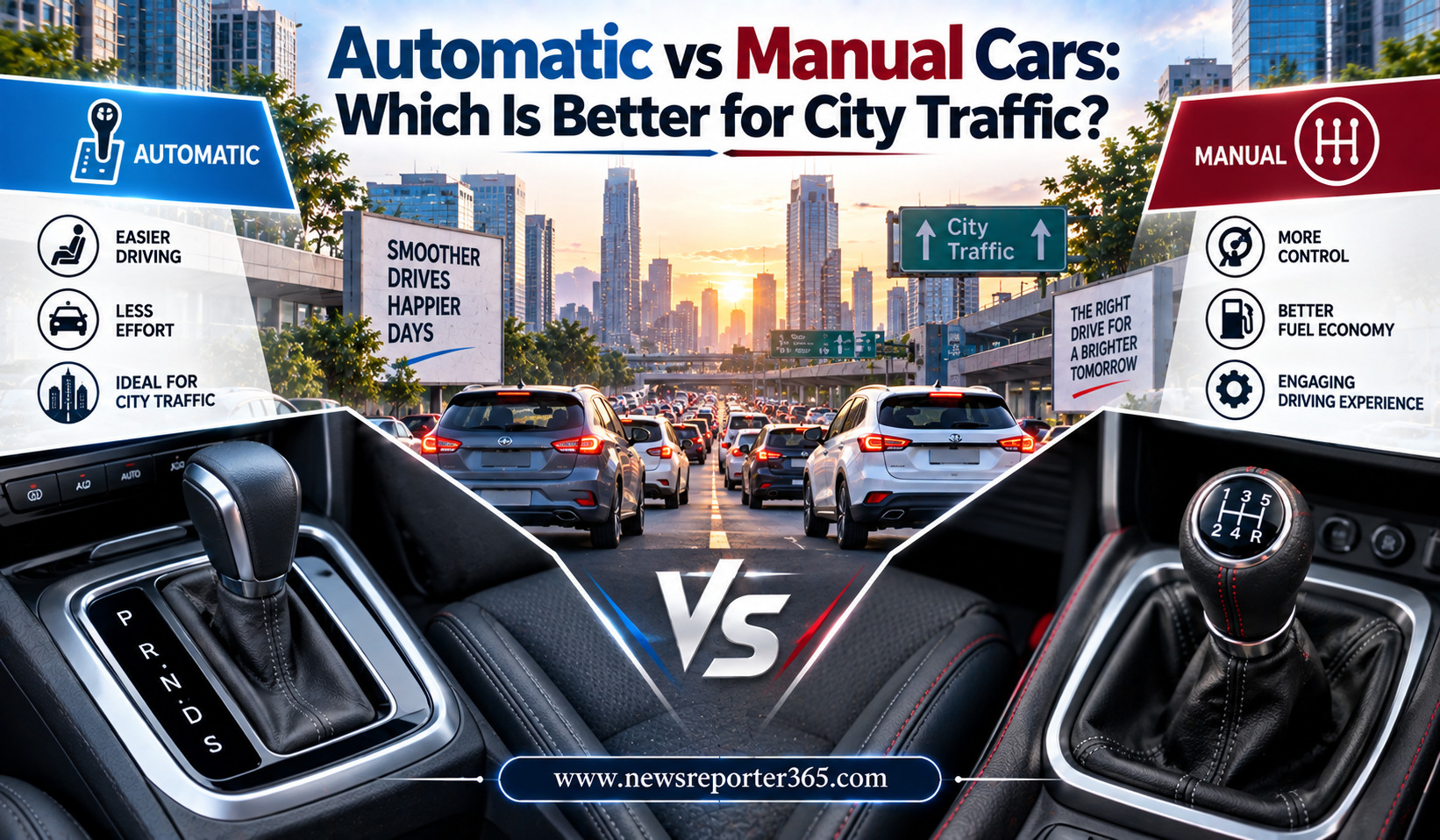
City driving has changed significantly as traffic volumes increase and daily commutes become longer. For many car buyers, the choice between an automatic and manual transmission is no longer simply about driving preference. It can influence comfort, fuel expenses, maintenance, convenience and even how tiring a daily commute feels.
Manual cars have traditionally been popular because they are generally familiar, affordable and available across a wide range of models. However, automatic cars have become increasingly attractive to urban drivers because they remove the need for frequent clutch operation and gear changes. In stop-and-go traffic, that difference can become noticeable within minutes.
Neither transmission is universally better. The right choice depends on driving conditions, budget, expected usage and the driver’s priorities. Understanding how each option behaves in real city traffic can help buyers make a more practical decision.
Why City Traffic Changes the Transmission Choice
Driving on an open highway is very different from navigating a crowded urban road. City drivers frequently accelerate, slow down, stop at signals and move forward again within short distances.
With a manual transmission, the driver has to coordinate the clutch, accelerator and gear lever repeatedly. During a long traffic jam, this can become physically tiring. Frequent clutch use can also increase wear over time, particularly when the driver is not smooth with clutch operation.
An automatic transmission handles gear selection for the driver. This means the driver can concentrate more on steering, braking and surrounding traffic instead of continuously changing gears.
This convenience is one of the main reasons automatic cars have gained popularity among urban buyers.
Manual Cars Still Have Important Advantages
Manual transmissions remain relevant because they offer a combination of affordability, control and mechanical familiarity. Many buyers prefer being directly involved in selecting gears, especially when driving on slopes or winding roads.
A manual car can also have a lower purchase price than an equivalent automatic variant. For buyers working with a strict budget, the price difference can be significant enough to influence the final decision.
Manual cars are also widely understood by independent workshops and mechanics. This can be useful for owners who prioritise straightforward servicing and want a broader choice of repair facilities.
For drivers who enjoy an involved driving experience or regularly travel on roads where engine braking and manual gear selection are useful, a manual transmission can still be appealing.
Automatic Cars Reduce the Effort of Stop-and-Go Driving
The biggest advantage of an automatic car in city traffic is convenience. The transmission selects gears based on driving conditions, allowing the driver to operate the accelerator and brake without repeatedly using a clutch.
This becomes particularly useful in traffic congestion. During a slow-moving commute, the driver can gradually move the vehicle forward without constantly pressing and releasing the clutch.
Automatic cars can also be easier for new drivers to operate. With fewer controls to coordinate, the learning process can feel less demanding.
However, automatic technology is not a single category. Different systems provide different driving experiences, efficiency levels and maintenance requirements.
Understanding Different Automatic Transmissions
Buyers should not treat every automatic car as identical. Automated manual transmissions, torque-converter automatics, continuously variable transmissions and dual-clutch systems work differently.
An AMT can offer automatic operation at a relatively accessible price, although gear changes may sometimes feel more noticeable. A torque-converter automatic generally offers smooth operation and can be well suited to urban driving.
CVT systems are designed to provide smooth acceleration without conventional fixed gear changes. They can work well in traffic, although the driving sensation may feel different from a traditional automatic.
Dual-clutch transmissions can provide quick gear changes and strong performance, but their behaviour in slow-moving traffic can vary between models.
The best option therefore depends on the specific vehicle rather than simply choosing “automatic” as a category.
Automatic vs Manual: City Driving Comparison
| Factor | Automatic | Manual |
| Stop-and-go traffic | More convenient | More tiring |
| Clutch operation | Not required | Required |
| Ease of learning | Generally easier | Requires more coordination |
| Purchase price | Often higher | Usually lower |
| Driver involvement | Lower | Higher |
| City comfort | Generally strong | Depends on driver |
| Fuel efficiency | Varies by transmission | Often predictable |
| Maintenance | Depends on transmission type | Generally familiar |
| Traffic fatigue | Lower for many drivers | Can be higher |
| Driving control | Managed electronically/mechanically | Direct gear selection |
Fuel Efficiency Is Not a Simple Automatic vs Manual Question
Older assumptions often suggest that manual cars are always more fuel-efficient than automatics. Modern transmission technology has made this comparison more complicated.
A well-designed automatic can deliver competitive efficiency because modern systems use sophisticated gear management. Hybrid powertrains and advanced automatic transmissions can also change the overall efficiency equation.
At the same time, driving behaviour remains extremely important. Aggressive acceleration, frequent hard braking, excessive idling and heavy air-conditioner use can affect fuel consumption regardless of transmission type.
Buyers should therefore compare the real-world efficiency of the specific models they are considering instead of assuming one transmission will always consume less fuel.
Maintenance and Repair Costs Need Attention
Maintenance is another area where the two transmission types can differ.
Manual transmissions use a clutch system that can eventually require replacement depending on driving style and usage. Drivers who frequently ride the clutch or operate in heavy traffic may experience greater clutch wear.
Automatic transmissions do not have a conventional clutch pedal, but their systems can contain more complex components and specialised electronics. Depending on the transmission type, repairs can be more expensive if a major component develops a problem outside warranty.
Regular servicing and following the manufacturer’s maintenance schedule are therefore important for both types.
City Parking Is Easier With an Automatic
Parking in crowded urban areas can involve repeated forward and reverse movements. An automatic car can simplify this process because the driver does not have to coordinate clutch engagement every time the vehicle moves slowly.
This can be especially useful in underground parking areas, narrow residential lanes and busy shopping-centre parking lots.
Manual cars can perform these manoeuvres perfectly well, but they require more clutch and gear coordination. Experienced drivers may find this effortless, while newer drivers may need more practice.
Automatic Cars Can Be Better for Long Commutes
A long daily commute can change the value proposition of an automatic transmission. Even if the car is driven at relatively low speeds, eliminating repeated clutch operation can reduce physical effort.
For professionals who spend an hour or more in traffic each day, this convenience can become one of the most noticeable benefits of owning an automatic.
The higher initial cost may therefore be justified for some buyers if the vehicle is used frequently. However, buyers with short commutes and limited budgets may find a manual car perfectly adequate.
Manual Cars Can Offer Greater Driver Control
A manual transmission gives the driver direct control over gear selection. This can be useful when climbing steep roads, descending slopes or preparing for overtaking.
Drivers can select a lower gear to increase engine braking or maintain a particular level of engine response. While modern automatics also offer various driving modes and manual-selection functions, the experience is different.
For enthusiasts, the involvement of shifting gears can itself be part of the driving experience. City traffic, however, can reduce some of the enjoyment because the driver may spend more time changing gears than actually enjoying the road.
Three Questions to Ask Before Choosing
Rather than deciding based only on general opinions, buyers should consider their own driving habits:
- How much time do you spend in traffic? Frequent congestion makes the convenience of an automatic more valuable.
- What is your purchase budget? If keeping the initial cost low is important, a manual variant may offer better value.
- How do you like to drive? Drivers who enjoy greater control may prefer manual, while those prioritising convenience may prefer automatic.
These questions can make the decision more relevant to individual requirements.
Which Automatic Type Is Best for City Driving?
There is no universal winner because traffic conditions, vehicle design and transmission tuning all matter. Torque-converter automatics can provide smooth low-speed operation, while CVTs can deliver seamless acceleration.
AMTs may appeal to buyers who want automatic convenience at a lower price, although their shift behaviour can vary. Dual-clutch systems can provide quick gear changes but may behave differently in heavy traffic depending on the vehicle.
A test drive is therefore particularly important. Buyers should spend time driving at low speeds, accelerating gently, stopping frequently and parking before making a decision.
Resale Value and Future Use Also Matter
The transmission choice can also influence the future resale experience. Automatic cars are becoming increasingly common in urban markets, particularly as buyers look for easier daily driving.
However, resale value depends on several factors, including brand reputation, vehicle condition, service history, age and demand for the specific model.
Buyers should also consider how their needs could change. Someone who currently drives mostly on weekends may eventually have a longer daily commute. Choosing a transmission that remains comfortable for future usage can help extend the vehicle’s usefulness.
Is an Automatic Worth the Extra Cost?
For a buyer who spends significant time in urban traffic, an automatic can provide a meaningful quality-of-life improvement. The extra purchase cost effectively pays for convenience, particularly when the car is used every day.
However, the financial calculation should include more than the upfront price. Buyers should compare insurance, maintenance, fuel efficiency and expected ownership duration.
If the automatic variant costs substantially more but the vehicle will be driven only occasionally, the additional expense may be harder to justify.
The Best Choice Depends on the Driver
The debate between automatic and manual cars does not have a single answer. City traffic generally gives automatic transmissions an advantage because they reduce clutch operation and simplify low-speed driving.
Manual cars continue to make sense for buyers who want a lower initial price, greater control or a familiar driving experience. They can also be perfectly comfortable in urban environments when driven by someone who is accustomed to manual gear changes.
The most important factor is therefore the driver’s routine. A daily commuter spending hours in congestion may value an automatic far more than someone who drives short distances on quieter roads.
Final Word
For modern city traffic, automatic cars offer a strong combination of convenience and reduced driving effort. They can make congested commutes, parking manoeuvres and slow-moving traffic easier to manage. This is particularly valuable for people who spend considerable time behind the wheel every day.
Manual cars, meanwhile, remain attractive because of their affordability, direct control and familiar mechanical layout. They can be an excellent choice for buyers who enjoy active driving or want to minimise the initial purchase cost.
Before deciding, buyers should test both types in realistic conditions. A short showroom drive may not reveal how a transmission feels after an hour in traffic. Comparing the actual purchase price, running costs, maintenance requirements and daily comfort can lead to a much better decision than relying on the automatic-versus-manual debate alone.
FAQs
1. Is an automatic car better for heavy city traffic?
For many drivers, yes. Automatic transmissions eliminate repeated clutch operation and can make stop-and-go traffic less tiring.
2. Are manual cars cheaper than automatics?
Manual variants are often cheaper to purchase than equivalent automatic versions, although the exact difference varies by model and variant.
3. Which transmission gives better mileage?
There is no universal answer. Modern automatics can be highly efficient, while manual efficiency depends heavily on gearing and driving style.
4. Is an automatic easier for new drivers?
Generally, yes. Without a clutch pedal and frequent gear changes, new drivers have fewer controls to coordinate.
5. Do automatic cars require more maintenance?
It depends on the transmission technology and vehicle. Some automatic systems are more complex than manual gearboxes, so buyers should check the manufacturer’s maintenance schedule and costs.