

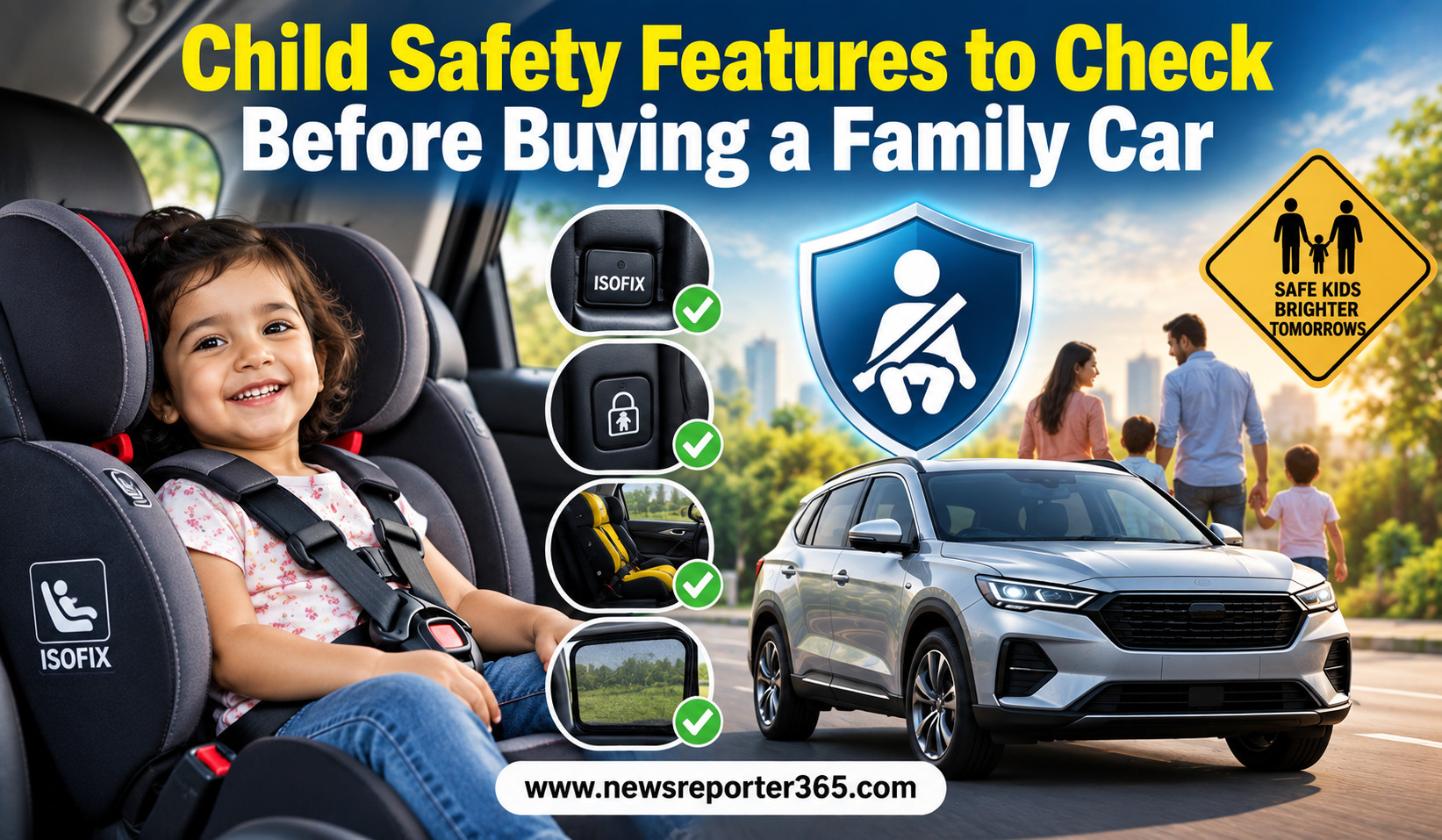
For families buying a new car, comfort, mileage, boot space and technology are often high on the priority list. However, child safety deserves equal attention, particularly for parents who regularly travel with young children. A family car is not just a means of transportation; it is often used for school trips, weekend travel, family functions and long road journeys. Choosing the right safety equipment can therefore make a meaningful difference.
Modern cars offer several features designed to protect younger passengers, but not every feature is available in every model or variant. Some safety equipment may also work differently depending on the vehicle’s design. Parents should therefore understand what each feature does instead of choosing a car simply because it has a long list of safety specifications.
From child-seat mounting systems and rear seat belts to airbags and door locks, several details deserve attention before making a purchase. Here is a closer look at the important child-safety features families should check.
Why Child Safety Requires Special Attention
Children are more vulnerable to injuries in vehicle crashes because their bodies are still developing. Their height, weight and seating requirements are different from those of adults. This is why simply placing a child in an adult seat belt may not always provide the appropriate level of protection.
A family car should make it easy for parents to secure children correctly. The rear seats are particularly important because they are commonly used for young passengers. The availability of suitable restraint systems and practical child-safety features can make everyday travel more convenient as well as safer.
Parents should also remember that safety technology cannot replace responsible driving. Correct seating, proper restraint use and careful driving remain essential regardless of how many safety features a vehicle offers.
ISOFIX Child-Seat Mounts
One of the most useful features parents should check is the availability of ISOFIX mounting points. ISOFIX is designed to provide a standardized way of attaching compatible child seats to a vehicle. Instead of depending entirely on the vehicle’s seat belt, a compatible child seat can be connected to dedicated mounting points.
For parents who frequently use a child seat, ISOFIX can make installation more straightforward. It can also reduce the possibility of incorrect installation when the appropriate compatible seat and vehicle mounting system are used correctly.
However, the presence of ISOFIX does not automatically mean that every child seat will fit. Parents should check the compatibility requirements of the child seat and the vehicle before buying either one.
Rear Seat Belts Matter
Seat belts are among the most important safety systems in any car, and rear passengers should not be overlooked. Families should check whether the rear seats have proper three-point seat belts and whether they are comfortable and practical for the intended occupants.
A child should always be appropriately restrained according to their size and the child-restraint manufacturer’s instructions. Parents should also avoid allowing children to share one seat belt with another passenger.
The position and accessibility of rear seat belts can also affect everyday usability. During a showroom visit, parents can check whether child seats can be installed without interfering with the seat belt buckles or other seating positions.
Rear Door Child Locks
Rear door child locks are a simple but valuable feature for families. They are designed to prevent children from opening the rear doors from inside the vehicle when activated.
This feature becomes particularly useful when children are old enough to reach door handles but may not understand the dangers of opening a moving vehicle’s door. Parents should understand how the child-lock system works and check whether it is easy to activate before starting a journey.
Some vehicles also offer additional electronic controls, but the basic purpose remains the same: reducing the possibility of an accidental rear-door opening.
Rear Window Controls
Power windows are convenient, but they can create safety concerns when young children are sitting in the rear. A useful family-car feature is the ability for the driver to control or disable rear window operation.
Parents should check whether the vehicle has a window-lock function and understand how it operates. This can help prevent children from accidentally operating the windows while the car is moving.
The physical placement of switches can also matter. Controls that are easily accessible to children may require greater attention from parents, particularly during long journeys.
Airbags and Child Passengers
Airbags provide important protection for vehicle occupants, but parents need to understand how they interact with child seating arrangements. Front passenger airbags can create risks for certain child-seat configurations, particularly when a rear-facing child restraint is placed in the front passenger seat.
For this reason, child restraints should be installed according to both the vehicle manufacturer’s instructions and the child-seat manufacturer’s guidance. Parents should never assume that an airbag is automatically beneficial in every seating situation.
A vehicle with multiple airbags can provide broader occupant protection, but airbag count should not be the only measure of safety. The vehicle’s crash performance, seat-belt systems and child-restraint compatibility are also important.
Curtain Airbags for Family Cars
Curtain airbags can be another useful safety feature to consider. These airbags are designed to deploy along the side window area during certain qualifying crashes and can provide additional protection for occupants’ head areas.
For families, curtain airbags can be particularly relevant because children commonly travel in the rear seats. However, parents should remember that airbags are supplementary safety systems. Children still need to be correctly secured in an appropriate restraint.
When comparing vehicles, it is useful to check whether curtain airbags are available across the entire range or only on selected variants.
What About Rear-Seat Visibility?
Not every important child-safety feature is an electronic system. Visibility and cabin design also matter. Parents should be able to monitor young passengers without being excessively distracted from driving.
A vehicle with good rear visibility and practical interior space can make family travel easier. Some cars may also offer additional mirrors or camera-based systems that help drivers keep an eye on the rear cabin.
However, drivers should avoid turning around repeatedly while driving. Any monitoring system should support safe driving rather than become a source of distraction.
Electronic Stability Control and Child Safety
Electronic Stability Control, commonly known as ESC, is primarily an active safety system rather than a child-specific feature. Its purpose is to help the driver maintain control when the vehicle begins to lose stability under certain driving conditions.
This matters for family cars because preventing or reducing the severity of a loss-of-control event benefits everyone inside the vehicle, including children.
Other active safety systems can also contribute to overall protection. Depending on the model, buyers may find features such as traction control, autonomous emergency braking or other driver-assistance technologies.
Parents should consider these systems as part of the vehicle’s complete safety package rather than focusing only on child-specific equipment.
Child Safety Features Worth Checking
Before purchasing a family car, parents should examine the vehicle carefully rather than relying solely on the brochure. A short checklist can help make the comparison easier:
- ISOFIX or compatible child-seat mounting points
- Three-point seat belts for rear passengers
- Rear door child locks
- Rear window lock controls
- Suitable airbag configuration
- Curtain airbags where available
- Electronic stability control
- Strong crash-test performance
The exact features available can vary by model and variant, so buyers should confirm the specifications of the particular version they intend to purchase.
Comparison of Important Child-Safety Features
| Safety Feature | Why It Matters for Families | What Parents Should Check |
| ISOFIX mounts | Helps secure compatible child seats | Compatibility and mounting locations |
| Three-point rear belts | Provides appropriate restraint for passengers | Availability and ease of use |
| Child locks | Helps prevent accidental rear-door opening | Operation and activation method |
| Window lock | Limits rear window operation | Driver-control accessibility |
| Curtain airbags | Adds protection in certain side crashes | Availability across variants |
| ESC | Helps maintain vehicle stability | Whether offered as standard |
| Crash-test performance | Indicates performance in tested crash scenarios | Rating and applicable test protocol |
Check the Actual Rear Seat Before Buying
A common mistake is to read the safety specification sheet but never test how a child seat actually fits inside the car. Families should take the opportunity during a showroom visit to examine the rear seat.
Parents can check whether the child seat sits securely, whether the mounting points are accessible and whether there is enough space for other passengers. They should also consider how easy it will be to place a child into the seat when the vehicle is parked in a tight space.
This practical check can be particularly important for families with more than one child, because installing multiple restraints may affect the usable rear-seat space.
Child Safety Is More Than a Feature List
The safest family car is not necessarily the one with the longest list of features. Vehicle structure, crash performance, restraint systems, active safety technology and proper child-seat usage all work together.
Parents should also consider the age and size of their children when choosing a vehicle. A family with an infant may have different requirements from a family with older children. As children grow, their seating and restraint needs can change.
The vehicle should therefore be selected with both current requirements and expected family use in mind.
Common Mistakes Parents Should Avoid
Several mistakes can reduce the benefits of a vehicle’s safety systems. One of the biggest is using a child seat incorrectly or failing to check its compatibility with the vehicle. Another is allowing children to travel without proper restraints for short journeys.
Parents should also avoid placing a rear-facing child restraint in a front passenger position with an active passenger airbag unless the vehicle and restraint manufacturers specifically permit that arrangement.
Other mistakes include:
- Choosing a car based only on the number of airbags.
- Ignoring rear-seat belt design and accessibility.
- Failing to test child-seat compatibility before purchase.
- Assuming electronic safety features replace careful driving.
Final Thoughts
Child safety should be one of the first considerations when selecting a family car, not an afterthought. Features such as ISOFIX mounts, rear three-point seat belts, child locks, window controls and appropriate airbags can make a vehicle better suited to families.
At the same time, buyers should look at the complete safety picture. Crash-test performance, vehicle structure, electronic stability control and other active safety technologies can be just as important as child-specific equipment.
Before buying, parents should inspect the actual car, understand how its safety systems work and, where possible, test the intended child restraint in the rear seat. A little extra attention during the buying process can help families choose a vehicle that provides a safer and more practical environment for everyday journeys.
FAQs
What is the most important child-safety feature in a family car?
There is no single feature that guarantees child safety. A properly installed and suitable child restraint, combined with good seat belts, strong crash protection and other safety systems, is important.
Is ISOFIX necessary for a family car?
ISOFIX can make installing compatible child seats easier and more consistent. However, parents should still follow the child-seat manufacturer’s installation instructions.
Should children sit in the front passenger seat?
Young children are generally better accommodated in an appropriate rear-seat restraint. Parents should always follow the vehicle and child-restraint manufacturer’s instructions regarding seating position and airbags.
Are curtain airbags useful for children?
Curtain airbags can provide additional protection to occupants during certain side-impact crashes. They are an additional layer of protection and do not replace child restraints or seat belts.
What should parents check during a showroom visit?
Parents should inspect the rear seating area, check child-seat mounting points, test seat-belt accessibility, understand the child-lock system and confirm that the intended child seat fits properly.