

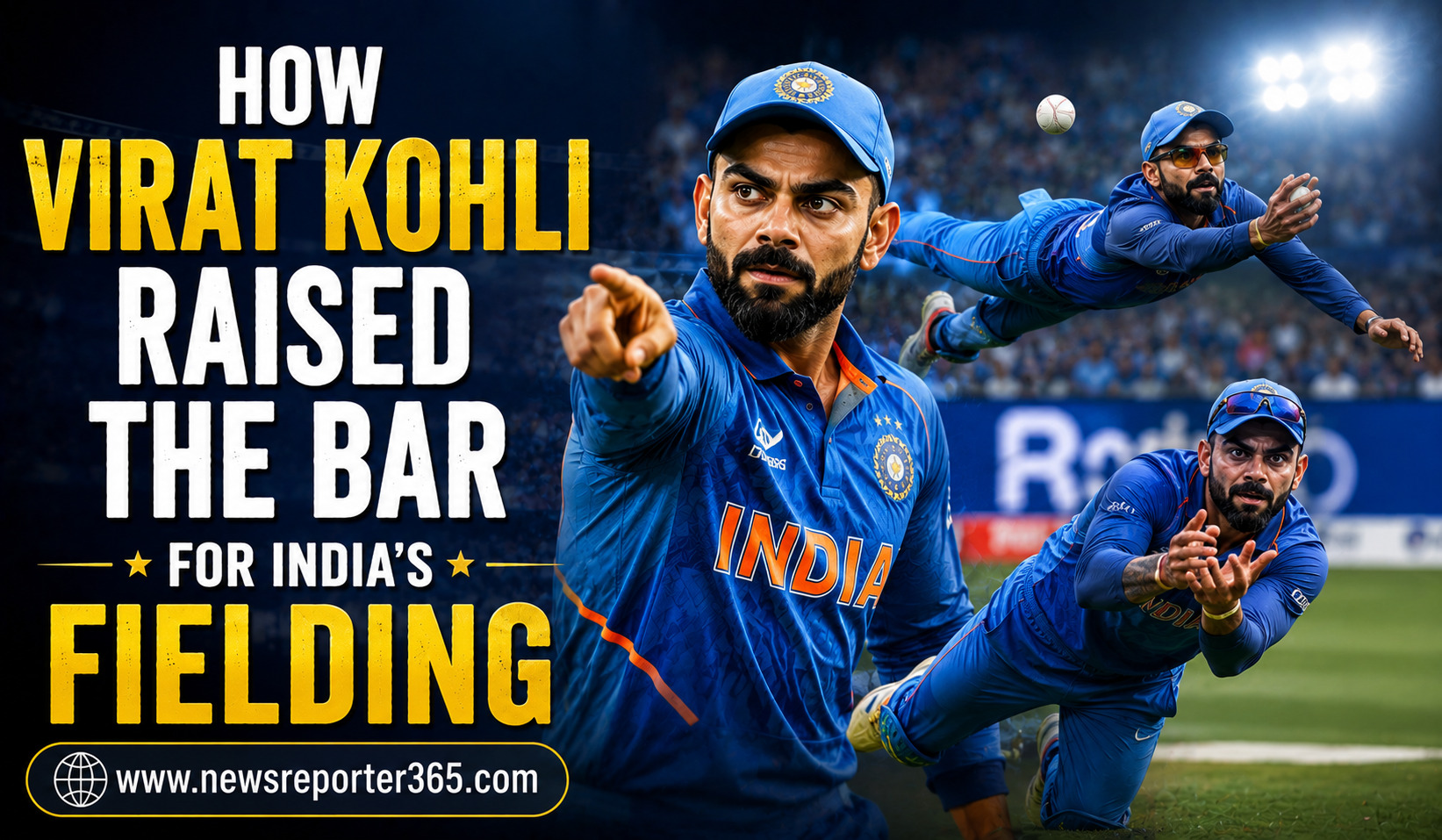
Virat Kohli is widely recognised for his batting records, leadership and remarkable fitness, but his influence on Indian cricket extends far beyond his performances with the bat. One of his most important contributions has been changing the way Indian cricketers approach fielding.
For generations, India produced outstanding batters and quality spin bowlers, but fielding was not always considered an equally important part of the team’s identity. Kohli helped change that mindset. His intensity on the field, athleticism, fitness standards and demand for commitment turned fielding into a major part of India’s modern cricket culture.
From diving stops at point to spectacular catches in the deep, Kohli demonstrated that elite fielding could change matches. More importantly, he helped create an environment where every player was expected to contribute in the field.
His influence can be seen across India’s current generation of cricketers, many of whom combine batting or bowling ability with exceptional athleticism.
India’s Fielding Before the Kohli Era
Indian cricket has always had talented fielders. Players such as Kapil Dev, Mohammad Azharuddin, Robin Singh, Ajay Jadeja and Yuvraj Singh produced memorable moments in the field.
However, fielding was not always treated as a central selection criterion.
India’s traditional strength was batting, while spin bowling played a major role in the team’s identity. In some periods, the side included players who were excellent with bat or ball but less athletic in the field.
As international cricket became faster and more physically demanding, that approach started changing.
T20 cricket accelerated the transformation.
Shorter formats made every run important. A single misfield could change the result of a match, while a brilliant catch could remove a dangerous batter.
Kohli emerged during this changing period and became one of the strongest advocates for elite fielding.
Virat Kohli’s Athleticism
Kohli’s fielding has always been closely connected to his athletic ability.
He developed a reputation for being energetic, quick and highly alert.
Whether stationed at cover, point, midwicket or in the outfield, he regularly attempted difficult catches and diving stops.
His ability to move quickly across the ground allowed him to save runs that many players might have allowed through.
But his impact was not only about spectacular moments.
Kohli’s biggest contribution was consistency.
He treated routine fielding as seriously as difficult catches.
That attitude helped establish the idea that professional fielders should be prepared for every delivery.
Fitness Changed His Fielding
One of the biggest reasons behind Kohli’s fielding standards is his commitment to fitness.
Kohli transformed his physical conditioning during his career.
He adopted structured training, improved his diet and focused heavily on maintaining athletic performance.
The benefits were obvious in his fielding.
Greater strength and mobility allowed him to cover ground quickly, maintain balance while diving and recover rapidly after difficult movements.
His fitness also helped him maintain intensity throughout long matches.
This became especially important in Test cricket, where players can spend several hours on the field.
Kohli demonstrated that fitness was not simply about batting performance. It could directly improve fielding.
Fielding Became Part of India’s Identity
As Kohli became a senior player and eventually captain, India’s approach to fielding became more demanding.
Players were expected to be energetic and alert regardless of their primary role.
This meant that bowlers and specialist batters were also required to improve their fielding.
The change was significant because it created a team culture where fielding was no longer considered secondary.
Every player had responsibilities.
Kohli’s own behaviour reinforced this message.
He celebrated outstanding fielding with the same intensity as wickets and boundaries.
A diving stop could generate the same enthusiasm as a six.
That emotional response showed younger players that fielding mattered.
The Rise of India’s Young Fielders
During Kohli’s leadership era, India developed a generation of athletic cricketers.
Players such as Ravindra Jadeja, Hardik Pandya, KL Rahul, Shreyas Iyer, Suryakumar Yadav and others became known for their fielding abilities.
Ravindra Jadeja became particularly famous for his speed, throwing accuracy and ability to take spectacular catches.
Hardik Pandya developed into a strong boundary fielder.
Suryakumar Yadav became known for athletic catches and quick reactions.
KL Rahul has also established himself as an excellent wicketkeeper and outfielder.
The growth of this generation reflects the broader change in India’s cricket culture.
Ravindra Jadeja and the New Fielding Standard
Ravindra Jadeja deserves special mention when discussing India’s fielding transformation.
Jadeja’s fielding has become a weapon in itself.
His throwing ability allows him to attack the stumps from difficult positions, while his speed enables him to stop boundaries.
His catches at point and in the deep have become regular highlights.
Kohli and Jadeja also shared a highly competitive approach to fielding.
Their energy created an environment where players were encouraged to push their limits.
Jadeja’s development showed that an elite fielder could directly influence team selection and match strategy.
Fielding as a Match-Winning Skill
One of Kohli’s biggest contributions was helping players understand the value of individual runs saved.
A fielder who prevents four runs has effectively created a four-run advantage.
A direct hit can produce a wicket.
A difficult catch can remove a batter who might otherwise score another fifty runs.
This is particularly important in T20 cricket.
With margins becoming smaller, fielding can determine the result of a match.
Kohli’s approach encouraged Indian players to think about fielding as an active skill rather than something that simply happens between deliveries.
The Importance of Aggression
Kohli’s fielding style has always been aggressive.
He rarely stands passively in the field.
He constantly communicates with teammates, celebrates good deliveries and maintains energy.
This aggression can influence the opposition.
A batter facing a team filled with energetic fielders may feel additional pressure to take risky singles.
Close fielders can create the impression that easy runs are unavailable.
That psychological pressure is an important part of modern cricket.
Fielding During Test Cricket
Fielding intensity is particularly challenging in Test matches.
Players can spend long periods on the field, often under hot conditions.
Maintaining concentration for hundreds of deliveries requires physical and mental discipline.
Kohli’s fitness standards helped demonstrate that modern Test cricketers could maintain high fielding standards even late in an innings.
India’s improved athleticism became particularly visible in overseas conditions, where fast bowling and aggressive field placements demanded sharp fielders.
Impact on Overseas Cricket
India’s improved fielding standards became especially important during overseas tours.
Historically, overseas Test cricket was sometimes associated with India’s struggles in pace-friendly conditions.
Improved fitness and fielding helped change the overall competitiveness of the team.
Fast bowlers could maintain pressure knowing that chances were more likely to be taken.
Captains could use attacking fields with greater confidence.
A strong fielding unit also allowed bowlers to create pressure through singles and boundary prevention.
Kohli’s emphasis on fitness therefore had an impact beyond his own performances.
Fielding and Fast Bowling
Fielding standards are closely connected with fast bowling.
Fast bowlers often create edges and mistimed shots that require athletic fielders.
During Kohli’s leadership, India’s pace attack became one of its major strengths.
Players such as Jasprit Bumrah, Mohammed Shami and Mohammed Siraj generated frequent chances.
Having high-quality fielders behind them increased the value of those bowling performances.
Slip fielding also became important, especially in Test cricket.
India’s bowlers could attack aggressively because the team had greater confidence in its catching ability.
Kohli’s Famous Fielding Moments
Kohli has produced numerous memorable moments in the field throughout his career.
His diving catches, boundary saves and direct hits have regularly appeared in match highlights.
One of his defining characteristics is his willingness to attempt difficult catches rather than allowing the ball to pass.
Even when he does not complete the catch, his commitment sends a message to teammates.
His fielding highlights are spread across all three formats.
In T20 cricket, his speed and reaction time have been particularly valuable.
In ODIs, his ability to cover ground has made him effective in the inner circle and deep.
In Tests, his concentration and catching technique have been important in slips and close-catching positions.
Setting Standards Through Leadership
Kohli’s leadership role amplified his influence.
When the captain consistently demonstrates high fitness and fielding standards, younger players are more likely to follow.
Kohli rarely accepted low energy in the field.
He expected teammates to remain engaged regardless of the match situation.
This created accountability.
Players knew that fielding mistakes were not simply accepted as unavoidable.
At the same time, outstanding fielding was celebrated.
That combination of high expectations and positive reinforcement helped create a stronger fielding culture.
The Role of Fitness Coaches
Kohli’s transformation also coincided with greater professionalisation of fitness within Indian cricket.
Training became more structured.
Players worked on strength, speed, mobility, recovery and conditioning.
Nutrition also became a bigger part of professional preparation.
This meant that fielding ability could be developed systematically rather than relying only on natural athleticism.
Kohli’s personal commitment helped popularise this approach among Indian cricketers.
Fitness became part of the professional identity of a modern Indian player.
Young Players Entering the Team
One of the clearest signs of the change is the athleticism of younger Indian players.
Many modern Indian cricketers enter professional cricket with stronger physical preparation than previous generations.
They are expected to run quickly, dive safely, throw accurately and maintain concentration.
This means fielding is increasingly considered when teams select players.
A batter who can score runs and field brilliantly offers greater value than a batter who contributes only with the bat.
The same applies to all-rounders and bowlers.
The Influence on IPL Cricket
Kohli’s influence extends beyond international cricket.
The IPL has become an important platform for young Indian players, and franchises increasingly emphasise fielding.
Kohli’s presence in the IPL has helped reinforce this culture.
Royal Challengers Bengaluru have regularly included athletic players around him, and the team’s training environment has placed importance on fielding standards.
The IPL’s high-pressure nature makes fielding particularly important.
A single dropped catch can decide a match.
Young players therefore understand early in their careers that fielding can determine opportunities and results.
Fielding and Team Confidence
Good fielding can improve a team’s overall confidence.
When players trust each other to take difficult catches and save boundaries, bowlers can attack more aggressively.
Captains can set more attacking fields.
Batters also know that their team is likely to defend totals effectively.
Kohli’s teams often displayed this confidence.
Even when the opposition was scoring quickly, energetic fielding could create pressure and change momentum.
The Mental Side of Elite Fielding
Fielding is not only physical.
Concentration is equally important.
A player may stand at one position for several overs without seeing a chance and then suddenly have to react within seconds.
Kohli’s intensity helped promote constant engagement.
He was rarely disconnected from the game.
He watched every delivery, communicated with teammates and remained involved even when the ball was far away.
That mental preparation is particularly important in Test cricket.
India Compared With Other Top Teams
International cricket has become increasingly competitive in fielding.
Teams such as Australia, South Africa, New Zealand and England have traditionally placed strong emphasis on athleticism.
India’s transformation helped close the gap.
The modern Indian team is now capable of matching the world’s leading sides in terms of speed, catching and throwing.
This has been particularly noticeable in limited-overs cricket, where India regularly fields highly athletic combinations.
Kohli was an important part of this transformation.
Kohli’s Lasting Legacy
Virat Kohli’s batting records will probably remain the most visible part of his legacy.
However, his contribution to Indian fielding deserves equal recognition.
He helped create a culture in which fitness, intensity and athleticism became essential components of professional cricket.
His influence can be seen in younger players who treat fielding as a skill requiring training and preparation.
The standard has continued to rise.
Lessons for the Next Generation
Young cricketers can learn several important lessons from Kohli’s approach:
- Fitness improves every part of cricket, not just batting or bowling.
- Fielding requires regular practice and concentration.
- Energy on the field can influence teammates and opponents.
- Every saved run can matter in a close match.
- Athleticism can extend a player’s value to the team.
- Leadership is demonstrated through personal example.
These lessons are relevant well beyond professional cricket.
The Future of India’s Fielding
India’s fielding standards are likely to continue improving.
Modern cricket is becoming increasingly athletic, and players are entering professional systems at younger ages.
Technology is also helping teams analyse movement, reaction times, throwing accuracy and catching efficiency.
Training methods are becoming more specialised.
The next generation of Indian cricketers will likely be expected to meet even higher physical standards.
Kohli’s influence has helped establish the foundation for that future.
Conclusion
Virat Kohli’s impact on Indian cricket cannot be measured only through centuries, runs and victories.
He helped change the attitude toward fielding.
Through his fitness, intensity and personal example, he demonstrated that fielding should be treated as a match-winning discipline rather than a secondary responsibility.
His approach encouraged teammates to become faster, stronger and more committed in the field. The emergence of athletic players such as Ravindra Jadeja, Hardik Pandya, Suryakumar Yadav and KL Rahul reflects the broader transformation of Indian cricket.
The change is particularly significant because fielding influences every match, regardless of whether a player is batting or bowling.
A spectacular catch can remove a set batter. A diving stop can save four runs. A direct hit can change a match in seconds.
Kohli understood this value and consistently demanded the highest standards from himself.
His legacy as a batter and captain is already firmly established, but his influence on India’s fielding culture may prove to be one of his most lasting contributions.
Modern Indian cricket is fitter, faster and more athletic than ever. While many people contributed to that transformation, Virat Kohli played a major role in raising expectations and showing that elite fielding belongs at the heart of successful cricket.