

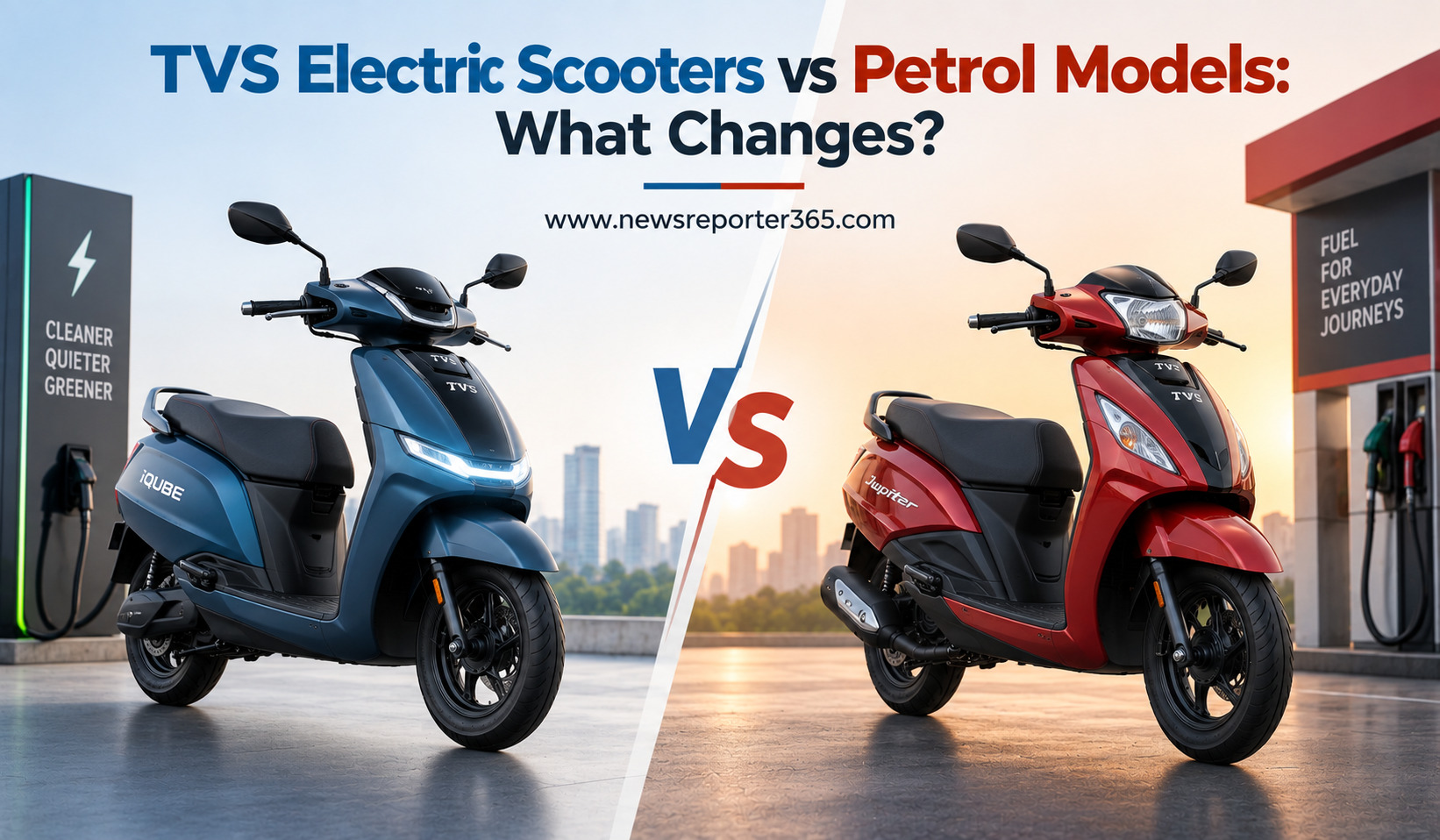
The scooter market in India is changing as electric models become a more common alternative to traditional petrol scooters. TVS Motor is one of the manufacturers offering customers both options, allowing buyers to choose between familiar petrol-powered scooters and newer electric models.
For someone considering a TVS scooter, the decision is no longer simply about choosing between different designs or engine sizes. Electric and petrol scooters can feel quite different to own and use. Charging requirements, running costs, performance delivery, maintenance, riding range and even the way the scooter responds to the throttle can vary.
TVS currently offers electric scooters such as the iQube, Orbiter and TVS X, while its petrol scooter portfolio includes popular models such as the Jupiter and NTORQ 125. Understanding the differences can help buyers decide which type better suits their everyday requirements.
The Biggest Difference Is the Power Source
The most obvious difference between the two types of scooters is how they produce energy.
A petrol scooter uses an internal-combustion engine. Fuel is stored in a tank and burned inside the engine to produce power. Models such as the TVS Jupiter 110, Jupiter 125 and NTORQ 125 use petrol engines and require conventional refuelling.
An electric scooter uses a battery and electric motor instead. The TVS iQube, Orbiter and TVS X are designed around battery-powered electric drivetrains.
This difference affects almost every part of ownership. Petrol scooters can be refuelled within minutes at a fuel station, while electric scooters need access to charging.
Electric Scooters Deliver Power Differently
Another noticeable difference comes from the way power reaches the rear wheel.
Petrol engines build power through engine revolutions and transmission operation. Riders become familiar with the sound and response of the engine as the scooter accelerates.
Electric motors, on the other hand, can deliver torque immediately. This can make an electric scooter feel particularly smooth during initial acceleration.
The difference can be especially noticeable in stop-and-go traffic. An electric scooter generally does not need the same engine-speed buildup associated with a petrol engine, creating a quiet and direct riding experience.
This does not mean every electric scooter is faster than every petrol model. Performance depends on the particular motor, battery, vehicle weight and riding mode.
Range and Refuelling Become Different Considerations
Range is one of the biggest practical differences between electric and petrol scooters.
A petrol scooter can generally be refuelled quickly, making longer journeys relatively straightforward. Riders do not normally need to plan their trip around charging points.
Electric scooters require more consideration. The rider needs to monitor the battery level and ensure that sufficient charge is available for the planned journey.
The TVS iQube illustrates how electric scooter range has developed. Depending on the battery and variant, the current iQube range includes versions with different IDC range figures, including up to 212 km for the 5.3 kWh variant.
The TVS Orbiter offers up to 158 km of IDC range with its 3.1 kWh battery variant, while the TVS X is positioned as a more performance-focused electric scooter.
However, IDC range should not be treated as an exact everyday distance. Actual range can change according to speed, traffic, rider weight, road conditions, riding mode and use of electrical features.
Charging Replaces the Familiar Fuel Stop
For petrol scooter owners, refuelling is a familiar part of ownership. A short visit to a fuel station can add enough fuel for many kilometres of riding.
Electric scooters replace this process with charging.
The advantage is that charging can often take place at home. The TVS iQube, for example, can be charged using a compatible portable charger, making home charging an important part of its ownership experience.
The Orbiter also uses a portable charger and is designed around convenient everyday charging.
For many urban riders, charging overnight can become part of a routine. Instead of visiting a petrol station during the week, the scooter can begin the next day with a higher battery level.
The main consideration is that charging takes significantly longer than filling a petrol tank.
Running Costs Can Change Significantly
Electric scooters can also change the economics of everyday riding.
A petrol scooter continuously requires fuel, and the cost of petrol can make a noticeable difference for people who cover large distances every month.
An electric scooter uses electricity instead. The cost per kilometre can therefore be considerably lower, although the actual saving depends on electricity tariffs, charging habits, riding conditions and the scooter’s efficiency.
This difference can become more meaningful for regular commuters. Someone who rides a scooter every day may have greater potential to benefit from lower energy costs than someone who travels only occasionally.
However, buyers should consider the complete ownership cost rather than looking only at energy expenses. Purchase price, financing, insurance, tyres, servicing and battery-related considerations also form part of the overall calculation.
Maintenance Requirements Are Not the Same
Petrol scooters have engines with several mechanical components that require periodic maintenance.
Engine oil, filters, spark plugs and other mechanical parts are part of conventional petrol-scooter servicing. The exact maintenance schedule depends on the model and manufacturer recommendations.
Electric scooters have fewer traditional engine components because they do not use an internal-combustion engine.
This can reduce some routine mechanical requirements. However, electric scooters are not maintenance-free. Brakes, tyres, suspension, bearings and other components still require inspection and servicing.
The battery and electrical systems also need to be treated according to the manufacturer’s recommendations.
Therefore, electric scooters can simplify some aspects of maintenance without eliminating the need for regular care.
Petrol Models Still Offer Familiar Practicality
TVS petrol scooters remain attractive because they fit easily into established Indian riding habits.
The Jupiter family, for example, is designed around everyday convenience, comfort and practicality. The Jupiter 110 uses a 110cc petrol engine, while the Jupiter 125 provides a larger 124.8cc engine and additional equipment.
The NTORQ 125 takes a sportier approach. Its 124.8cc three-valve engine produces 7.5 kW of maximum power, and the scooter is positioned toward riders who want a more energetic and technology-oriented petrol scooter.
These models do not require riders to think about battery charging or charging infrastructure. A full fuel tank can also provide a familiar sense of flexibility for longer journeys.
Electric Scooters Can Offer More Digital Features
Technology is another area where the differences can become noticeable.
Modern electric scooters are often designed around connected features because their electrical architecture makes it easier to integrate digital systems.
Depending on the model and variant, TVS electric scooters can offer features such as smartphone connectivity, navigation, remote vehicle information, riding statistics, alerts and over-the-air updates.
The TVS Orbiter, for example, combines connected functions with features such as Bluetooth connectivity, turn-by-turn navigation, distance-to-empty information and mobile-app functions.
The TVS X goes further with a large touchscreen display and a performance-focused technology package.
Petrol scooters such as the NTORQ 125 can also offer substantial connectivity and digital equipment, so this is not an advantage exclusive to electric models. The difference is that electric scooters are increasingly built around software and connected functions as part of their overall ownership experience.
Performance Depends on the Model
It would be inaccurate to say that electric scooters are always more powerful or that petrol scooters are always better performers.
The TVS range demonstrates why model selection matters.
The Orbiter is designed primarily around urban commuting, with a 68 km/h top speed and an emphasis on efficiency and practicality.
The TVS X takes a very different approach. It is a performance-oriented electric scooter with a claimed top speed of 105 km/h in TVS’s current technical information.
Meanwhile, the NTORQ 125 focuses on responsive petrol-powered performance, while the Jupiter range prioritises family-oriented practicality.
Therefore, buyers should compare specific models rather than treating all electric or petrol scooters as a single category.
Which Type Makes More Sense for Daily Riding?
Electric scooters can make particular sense for riders who have predictable daily routes, access to convenient home charging and want to reduce routine energy costs.
They can be especially attractive for urban commuters who travel moderate distances every day and return home regularly.
Petrol scooters can remain a practical choice for riders who frequently travel longer distances, have limited charging access or prefer the convenience of quick refuelling.
The right decision therefore depends less on whether electric technology is newer and more on how the scooter will actually be used.
The Buying Decision Is Becoming More Personal
TVS’s growing electric portfolio gives buyers more choice than before. Instead of replacing petrol scooters completely, electric models are creating another path for people with different commuting patterns.
The iQube focuses strongly on family-friendly electric mobility, the Orbiter targets everyday urban commuting, and the TVS X brings a more performance-oriented character to the electric category. On the petrol side, Jupiter models continue to focus on practical family transportation, while NTORQ 125 offers a sportier alternative.
This variety means buyers can compare not just prices but also charging access, daily distance, performance expectations, maintenance requirements and long-term ownership convenience.
Conclusion
The difference between TVS electric and petrol scooters goes far beyond the absence of a conventional engine.
Electric scooters change how riders think about charging, running costs, maintenance and daily energy use. Petrol scooters continue to offer quick refuelling, familiar mechanical operation and flexibility for riders who frequently cover longer distances.
Neither option is automatically the better choice for everyone. An urban commuter with home charging may find an electric scooter particularly convenient, while someone who values quick refuelling and unrestricted long-distance flexibility may still prefer petrol.
As TVS continues expanding both sides of its scooter portfolio, Indian buyers have more freedom to choose according to their actual riding habits. The most important question is therefore not simply whether an electric or petrol scooter is better, but which powertrain fits the rider’s everyday life more naturally.