

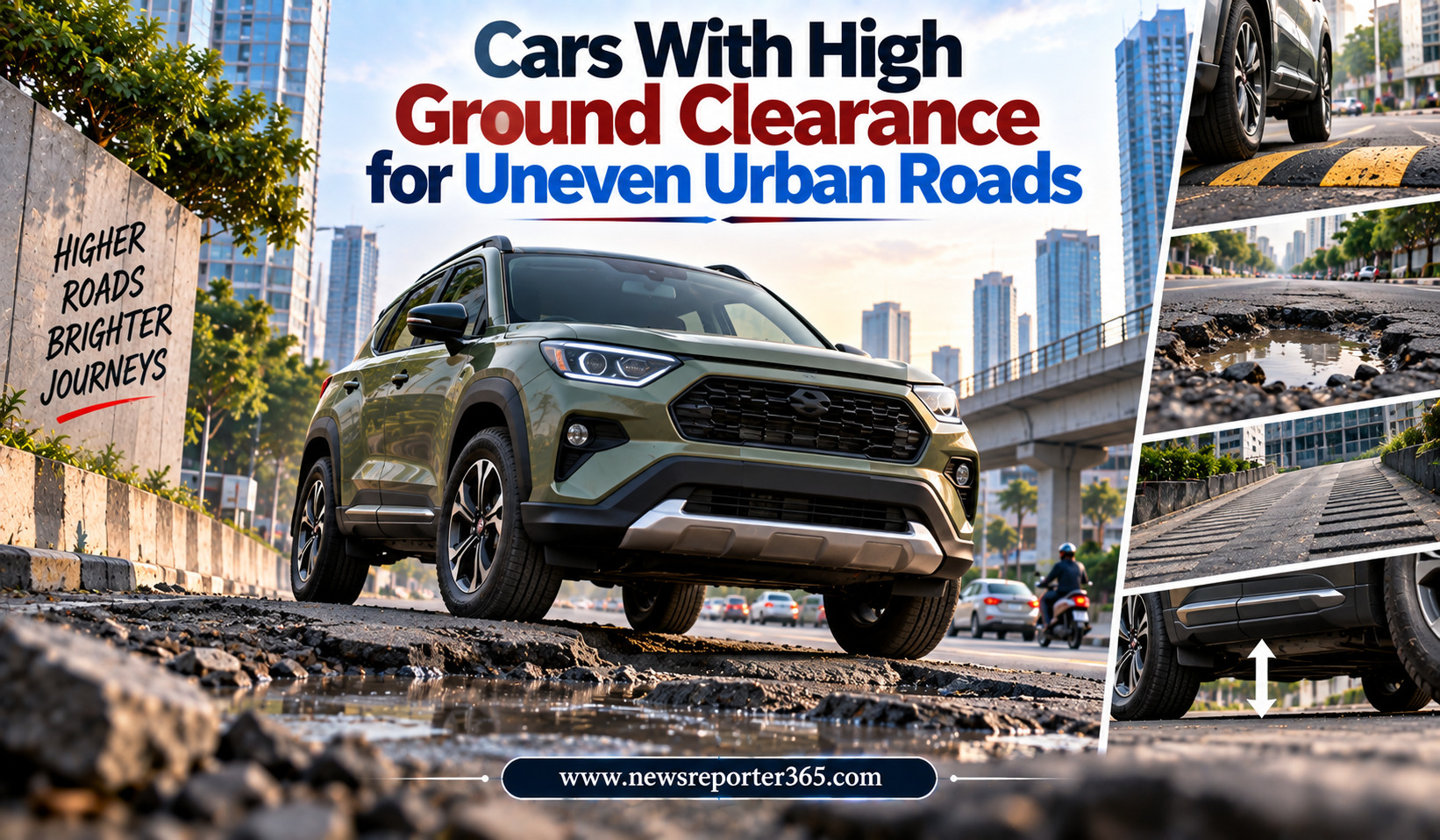
Indian cities are expanding rapidly, but road conditions do not always improve at the same pace. Potholes, uneven patches, steep speed breakers, broken shoulders and waterlogged streets are common challenges for daily drivers. For people who regularly deal with these conditions, ground clearance has become an important factor when choosing a car.
A car with good ground clearance can provide greater confidence when driving over rough sections of urban roads. It can reduce the chances of the underside touching the road when crossing speed breakers or deep potholes. However, ground clearance is not the only factor that determines how well a car handles poor roads. Tyre size, suspension tuning, wheelbase and overall vehicle dimensions also influence everyday usability.
What Does Ground Clearance Mean?
Ground clearance refers to the distance between the lowest point underneath a vehicle and the road surface. A greater distance gives the vehicle more room to clear obstacles such as speed breakers, potholes and uneven surfaces.
For urban driving, this can be particularly useful because road conditions can change within a short distance. A smooth road may suddenly lead to a damaged patch or a poorly designed speed breaker. Drivers of low-slung cars may need to slow down considerably or approach such obstacles carefully to avoid scraping the underbody.
It is important to understand that a higher ground-clearance figure does not automatically make one car better than another. The measurement may vary depending on tyre pressure, vehicle load and the way manufacturers calculate or publish the specification.
Why High Ground Clearance Matters in Cities
Urban roads create a unique combination of driving conditions. Unlike highways, where surfaces are generally more predictable, city routes can include potholes, road repairs, drainage covers, sharp ramps and uneven intersections.
A vehicle with adequate clearance gives the driver additional underbody protection when encountering such obstacles. It can also make it easier to cross large speed breakers without repeatedly worrying about the bumper or underbody touching the surface.
For families, ground clearance can become even more important when the vehicle is carrying several passengers and luggage. Additional weight can lower the vehicle’s suspension slightly, reducing the available clearance. A car that feels comfortable when driven alone may therefore behave differently when fully loaded.
Types of Cars That Offer Useful Ground Clearance
SUVs and compact SUVs are generally associated with high ground clearance, but buyers do not necessarily need a large SUV to deal with uneven urban roads. Several compact crossovers and practical family cars offer a useful balance between clearance, size and everyday drivability.
Models such as the Tata Nexon, Hyundai Venue, Kia Sonet and Maruti Suzuki Fronx are examples of vehicles that appeal to urban buyers looking for a raised driving position and practical dimensions.
Larger options such as the Mahindra Scorpio-N and Toyota Urban Cruiser Hyryder can offer a different ownership experience, with more road presence and SUV-oriented proportions.
The right choice depends on whether the buyer needs a compact city vehicle, a family car or a larger vehicle for mixed urban and highway use.
High Ground Clearance Does Not Mean Better Ride Quality
There is a common assumption that a vehicle with greater ground clearance will automatically provide a softer ride. That is not always true.
Ride comfort depends on suspension tuning, spring and damper characteristics, tyre sidewall, wheel size and vehicle weight. Two cars with similar ground clearance can therefore feel very different over the same broken road.
A well-tuned suspension can absorb bumps effectively while maintaining good body control. On the other hand, simply increasing the height of a vehicle does not guarantee a comfortable ride. Buyers should ideally test-drive a car over different types of surfaces before making a decision.
Compact SUVs Are Popular for Urban Road Conditions
Compact SUVs have become popular partly because they combine SUV-inspired proportions with dimensions that are manageable in city traffic. Their higher seating position can also give drivers a better view of surrounding traffic.
For urban users, this combination can be more useful than choosing a very large SUV. Compact dimensions make parking and navigating narrow roads easier, while the raised body provides additional clearance compared with many traditional hatchbacks and sedans.
This segment has also expanded considerably, giving buyers choices across different price points. Features such as automatic transmissions, rear cameras, connected technology and multiple safety systems can further improve the everyday experience.
Ground Clearance and Vehicle Load
One factor buyers sometimes overlook is the effect of passengers and luggage. When a car is heavily loaded, its suspension compresses and the effective distance between the underside and the road can decrease.
This is particularly relevant for families who regularly travel with four or five occupants. If a vehicle is primarily used for solo commuting, the impact may be less noticeable.
Therefore, buyers should consider how the car will normally be used instead of looking only at the manufacturer’s quoted ground-clearance number.
Tyres and Wheels Also Matter
Ground clearance is closely connected with the wheel and tyre combination. A tyre with a suitable sidewall can provide additional cushioning over broken surfaces and help protect the wheel from sharp impacts.
Larger wheels with low-profile tyres may improve appearance and, in some cases, handling response, but they can offer less sidewall protection against potholes. For an urban car that regularly encounters poor roads, tyre practicality can be more important than simply selecting the largest available wheel size.
Drivers should also maintain the recommended tyre pressure. Incorrect pressure can affect ride quality, handling, braking and tyre durability.
Key Factors to Consider Along With Ground Clearance
Before choosing a car for uneven city roads, buyers should look beyond the ground-clearance figure. Some of the most useful factors include:
- Suspension setup: A well-engineered suspension system can make a major difference on potholes and broken surfaces.
- Tyre sidewall: A practical tyre profile can provide better cushioning and protection on rough roads.
- Approach and departure angles: These can influence how easily a vehicle deals with steep ramps and sudden changes in road height.
- Vehicle dimensions: A compact car may be easier to manoeuvre around damaged roads and tight urban spaces than a larger SUV.
Cars With High Ground Clearance: What Should Buyers Look For?
The ideal vehicle for uneven urban roads should offer a sensible combination of clearance, suspension capability and manageable dimensions. Buyers who spend most of their time inside crowded cities may not need an oversized SUV simply because it has a high stance.
Compact SUVs can be a practical middle ground. They provide a raised driving position while remaining relatively easy to park and manoeuvre. Hatchbacks with good suspension and suitable tyre profiles can also perform well if the roads in the driver’s area are only moderately uneven.
For buyers who frequently travel outside the city, a larger SUV may make more sense because the additional ground clearance can be combined with stronger suspension components and better suitability for mixed road conditions.
Comparison of Popular High-Clearance Choices
| Vehicle type | Main advantage | Best suited for |
| Compact SUV | Balance of size and clearance | Daily city driving |
| Subcompact SUV | Easy to manoeuvre | Crowded urban areas |
| Crossover | Car-like driving with raised stance | Mixed city use |
| Mid-size SUV | More space and road presence | Families and longer trips |
| Large SUV | Greater capability and space | Mixed urban and rough-road use |
Specifications, tyre sizes and variants can differ, so buyers should check the latest manufacturer’s information before making a purchase.
Does More Ground Clearance Increase Safety?
Ground clearance itself should not be treated as a direct safety rating. Vehicle safety depends on a much wider range of factors, including crash structure, airbags, electronic stability systems, braking performance, tyre condition and driver assistance technology.
A higher vehicle can provide useful obstacle clearance, but buyers should not select a car solely because it sits higher from the road. A well-rounded safety package remains essential.
Modern buyers should therefore look at independent crash-test information where available, safety equipment, braking performance and overall vehicle stability alongside ground clearance.
How to Drive Safely on Uneven Roads
Even a high-clearance car needs to be driven carefully on damaged roads. Speed is particularly important. Hitting a pothole quickly can damage tyres, wheels, suspension components and steering parts regardless of the vehicle’s ground clearance.
Drivers should slow down before potholes and speed breakers rather than braking sharply while passing over them. Keeping an appropriate distance from other vehicles can also provide more time to identify road damage.
Regular inspection is equally important. Uneven roads can gradually affect wheel alignment, tyre condition and suspension components, so unusual steering behaviour, vibrations or uneven tyre wear should not be ignored.
Is an SUV Always the Best Choice?
Not necessarily. An SUV may provide better clearance and a higher seating position, but it can also be larger, heavier and more expensive than a hatchback or sedan.
For someone who primarily drives on well-maintained city roads with occasional potholes, a conventional car with a well-designed suspension may be perfectly adequate. Choosing an SUV simply for its appearance or road presence may not be necessary.
The best vehicle is the one that matches the actual roads, passenger requirements and driving pattern of the owner.
Conclusion
High ground clearance can be a valuable feature for everyday urban driving, particularly in cities where potholes, speed breakers and uneven surfaces are frequent. Compact SUVs and crossovers have become popular because they offer a practical combination of clearance, comfort, visibility and manageable dimensions.
However, buyers should avoid judging a car only by its ground-clearance figure. Suspension tuning, tyre profile, wheel size, vehicle load and overall dimensions can have an equally important effect on the driving experience.
For most urban buyers, a balanced car with adequate clearance and good suspension will be more useful than simply choosing the vehicle with the highest number. A careful test drive and comparison of the complete package can help ensure that the chosen car is comfortable and practical for everyday roads.
FAQs
What is considered good ground clearance for city driving?
There is no single number that works for every city. Adequate clearance combined with good suspension and suitable tyres is generally more important than chasing the highest specification.
Are compact SUVs good for uneven urban roads?
Yes. Compact SUVs can offer a useful combination of ground clearance, visibility and manageable dimensions, making them practical for many urban environments.
Does ground clearance affect fuel efficiency?
A higher-riding vehicle can have greater aerodynamic resistance, while larger and heavier vehicles can also consume more fuel. However, fuel efficiency depends on many factors beyond ground clearance.
Can passengers reduce a car’s ground clearance?
Yes. Additional passengers and luggage increase vehicle weight and can compress the suspension, reducing the available clearance to some extent.
Are bigger wheels better for pothole-filled roads?
Not necessarily. Larger wheels often come with lower-profile tyres, which can provide less cushioning against potholes. A suitable wheel and tyre combination is more important.