

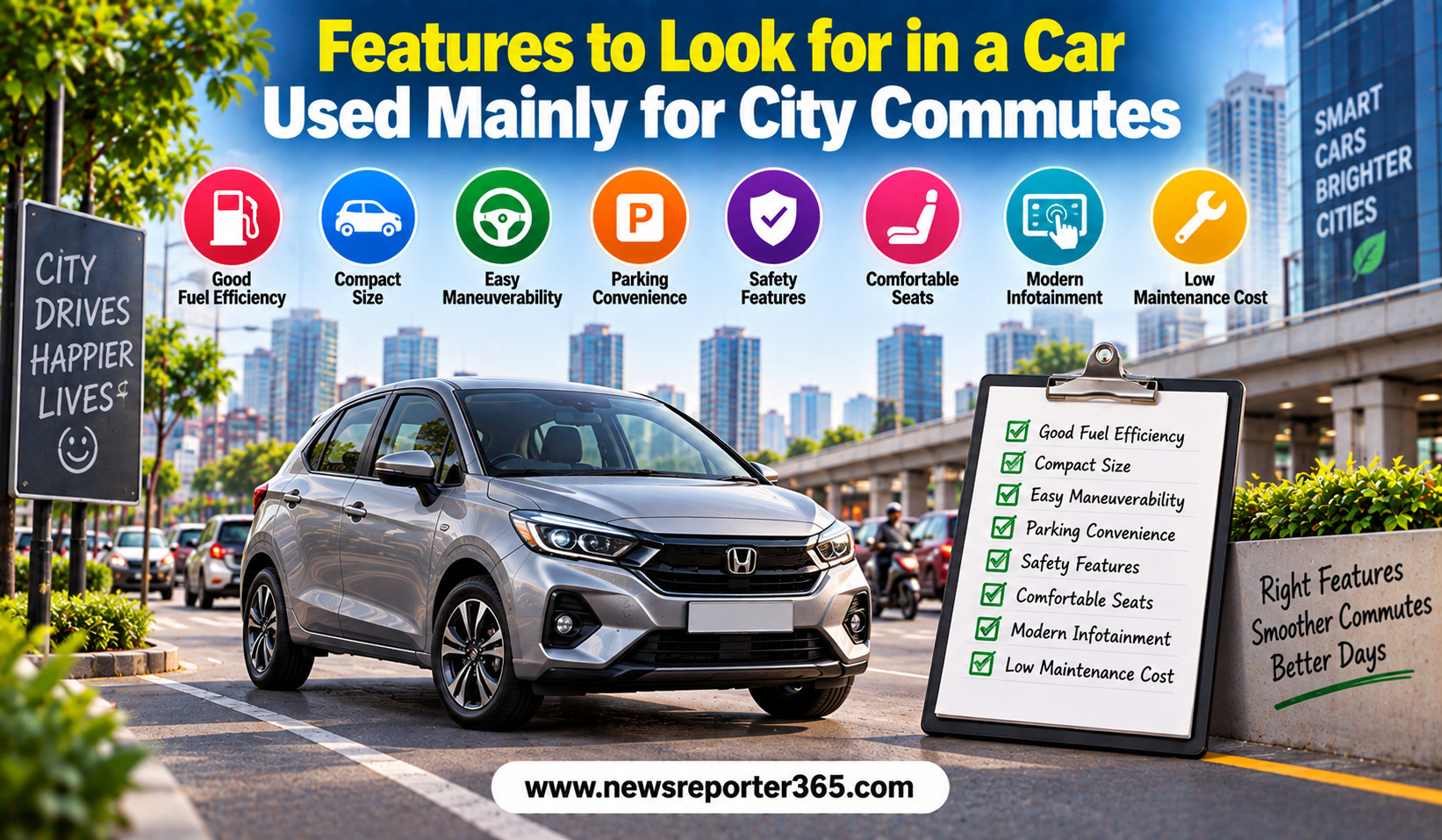
For many car buyers, daily driving does not involve long highway journeys or adventurous road trips. Instead, most of the time behind the wheel is spent travelling through busy city streets, traffic signals, narrow lanes, crowded parking areas and stop-and-go traffic. Because of this, choosing a car for city commuting requires a different approach from choosing a vehicle mainly for highway travel.
A car that feels powerful and exciting on an open road may not always be the most practical option for everyday urban driving. Features such as easy manoeuvrability, good visibility, comfortable seats, light steering, useful safety technology and efficient air conditioning can have a much bigger impact on daily convenience.
With increasing traffic congestion and rising ownership costs, buyers are also paying more attention to fuel efficiency, automatic transmissions, compact dimensions and technology that makes regular journeys less stressful. Here are the key features buyers should consider when choosing a car primarily for city commutes.
Compact Size Makes Urban Driving Easier
One of the most useful qualities in a city car is a manageable exterior size. Busy urban roads often have limited space, while parking lots and residential streets can be surprisingly tight. A compact car is generally easier to position in traffic and simpler to park.
Length and width both matter, but turning radius is equally important. A vehicle with a tight turning circle can make U-turns and narrow-road manoeuvres easier. This becomes particularly useful in crowded markets, residential areas and older parts of cities where roads may not have been designed for modern traffic volumes.
However, choosing a small car does not necessarily mean compromising on comfort. Many modern hatchbacks and compact SUVs use their interior space efficiently, offering reasonable cabin room while keeping their exterior dimensions suitable for city use.
Easy Steering and Good Visibility
City driving involves frequent steering corrections, lane changes and parking manoeuvres. Heavy steering can become tiring when a driver spends a significant amount of time in traffic. Light steering at lower speeds can make everyday driving more comfortable.
Visibility is another feature that should not be overlooked. A driver should have a clear view of the road ahead, surrounding vehicles and important areas near the car. A practical driving position combined with large windows and well-designed mirrors can make a noticeable difference.
The seating position is also a matter of personal preference. Some drivers prefer the lower driving position of a hatchback, while others like the slightly elevated view offered by a compact SUV. Buyers should sit inside the vehicle and check whether the bonnet, mirrors and surrounding traffic are easy to judge before making a decision.
Automatic Transmission Can Reduce Traffic Fatigue
Manual transmissions remain popular, but automatic gearboxes can be particularly convenient for people who regularly drive through heavy traffic. Constantly operating the clutch and changing gears can become tiring when traffic moves only a few metres at a time.
Different automatic technologies provide different driving experiences. Automated manual transmissions, continuously variable transmissions, torque-converter automatics and dual-clutch systems all have their own characteristics. A buyer should not judge an automatic car simply by the word “automatic”; a proper test drive in realistic traffic is more useful.
For city commuters, smooth low-speed behaviour should be one of the main considerations. An automatic that feels comfortable during crawling traffic may be more useful than one that is impressive only during quick acceleration.
Fuel Efficiency Still Matters
Daily commuting can add up to thousands of kilometres every year. Even a small difference in fuel consumption can therefore affect the total running cost over several years.
Official efficiency figures are useful for comparison, but actual consumption depends on traffic conditions, driving style, air-conditioner usage, road conditions and vehicle load. Heavy traffic can reduce efficiency significantly compared with controlled testing conditions.
Buyers should therefore consider the type of driving they actually do. Someone travelling short distances through severe congestion may have different priorities from someone commuting longer distances on relatively open city roads.
Strong Air Conditioning Is an Important City Feature
Air conditioning is not a luxury for many city drivers, particularly in hot weather. The cabin can become uncomfortable quickly when a vehicle is stuck in traffic under direct sunlight.
An effective air-conditioning system should cool the cabin reasonably quickly and maintain a comfortable temperature without requiring constant adjustments. Rear AC vents can also be useful for passengers, especially in larger cabins.
Buyers should test the air-conditioning system during a test drive rather than relying only on specifications. Cabin cooling, ventilation and fan noise can all affect the daily driving experience.
Safety Features Should Be a Priority
City driving may happen at relatively low speeds, but that does not mean safety features are less important. Urban roads contain pedestrians, motorcycles, bicycles, parked vehicles and sudden obstacles, creating many situations where driver assistance and passive safety systems can be valuable.
A sensible city car should have essential safety equipment such as airbags, ABS with electronic brake-force distribution, electronic stability control where offered, rear parking sensors and a strong body structure. A rear camera can also make parking and reversing easier.
Depending on the vehicle and budget, buyers may also consider advanced driver-assistance features. However, technology should complement attentive driving rather than replace it.
Parking Technology Can Save Time Every Day
Parking is one of the most frequent challenges faced by urban drivers. A vehicle may be easy to drive on the road but difficult to place accurately in a crowded parking area.
Rear parking sensors are therefore extremely useful. A reversing camera can provide additional visual information, while a 360-degree camera system can be especially helpful in larger vehicles.
Automatic parking assistance is another feature available in some cars. It can be convenient, although buyers should still understand the system’s limitations and remain responsible for controlling the vehicle.
Ground Clearance for Uneven City Roads
City roads are not always smooth. Speed breakers, potholes, uneven surfaces and poorly designed ramps can create problems for cars with very low ground clearance.
This does not mean buyers need an SUV simply for city driving. A hatchback with sensible ground clearance can work perfectly well for many urban environments. What matters is choosing a vehicle that can handle the roads commonly encountered during the daily commute.
A test drive over familiar roads can help determine whether the suspension and ground clearance are suitable for regular use.
Infotainment and Smartphone Connectivity
Modern drivers often use their phones for navigation, music and communication. Smartphone integration can therefore be more useful than having a large collection of built-in entertainment features.
Android Auto and Apple CarPlay can make navigation and audio controls easier to access through the vehicle’s display. Bluetooth connectivity, USB ports and steering-mounted controls can also improve convenience.
However, buyers should avoid choosing a car solely because it has a large touchscreen. A responsive interface, physical controls for frequently used functions and a clear display may be more useful in everyday driving.
Comfortable Seats Matter More Than Expected
A city commute can sometimes take much longer than the actual distance suggests. Traffic jams and frequent stops can turn a short journey into a long period behind the wheel.
Seat comfort should therefore be an important part of the buying decision. The driver’s seat should provide adequate support, while steering-wheel adjustment should allow the driver to maintain a comfortable posture.
Rear-seat comfort matters too, particularly if family members regularly use the car. Buyers should check legroom, headroom, seat cushioning and ease of entry before finalising their choice.
Features Worth Prioritising in a City Car
Not every feature needs to be treated equally. Buyers should focus on equipment that improves everyday driving rather than paying extra for features that may rarely be used.
| Feature | Why it matters for city driving |
| Compact dimensions | Easier manoeuvring and parking |
| Light steering | Reduces effort in traffic |
| Automatic transmission | More convenient in stop-and-go traffic |
| Good fuel efficiency | Helps control running costs |
| Rear parking sensors | Makes parking safer and easier |
| Rear camera | Improves visibility while reversing |
| Effective AC | Important for comfort in hot weather |
| Smartphone connectivity | Convenient navigation and entertainment |
| Good visibility | Helps monitor traffic and pedestrians |
| Safety equipment | Provides protection during collisions |
Do You Need an SUV for City Driving?
Compact SUVs have become popular among urban buyers because they offer a higher seating position, practical interiors and a strong road presence. However, an SUV is not automatically the best city car.
A larger vehicle can be more difficult to park and manoeuvre in narrow spaces. It can also consume more fuel depending on its engine, weight and driving conditions. For a driver whose primary requirement is commuting through crowded streets, a compact hatchback or compact SUV may be more practical than a large SUV.
The right choice depends on the driver’s priorities, family requirements, parking conditions and budget.
What About Engine Performance?
City driving does not necessarily require a high-powered engine. In most urban situations, smooth low-speed response and predictable acceleration are more useful than very high top speed.
An engine should provide enough power to move confidently through traffic, merge into faster-moving roads and handle inclines without excessive effort. Buyers should also pay attention to how the engine and transmission work together because refinement at low speeds can have a greater effect on daily comfort than peak power figures.
Test Drive Before Making the Final Decision
Specifications can tell buyers a lot about a car, but they cannot fully explain how it feels in real traffic. A proper test drive should include slow-moving traffic, parking, speed breakers, turns and, if possible, roads similar to the buyer’s regular commute.
During the test drive, buyers should notice steering weight, braking response, seat comfort, visibility, AC performance, gearbox behaviour and suspension comfort. These details may seem minor during a short drive but become important when experienced every day.
Final Word
Choosing a car mainly for city commuting is less about having the longest feature list and more about selecting the right combination of practical features. Compact dimensions, easy steering, good visibility, efficient air conditioning, useful parking technology, safety equipment and comfortable seats can make daily journeys significantly easier.
Automatic transmission and good fuel efficiency can also be valuable for drivers who spend considerable time in congested traffic. Meanwhile, smartphone connectivity and navigation features can add convenience without being the deciding factor.
The ideal city car is ultimately one that fits the driver’s roads, parking conditions, family needs and budget. A thoughtful test drive and careful comparison of everyday features can help buyers avoid paying extra for equipment they rarely need while ensuring that the essentials are covered.
FAQs
1. What is the most important feature in a city car?
There is no single feature that suits every driver, but easy manoeuvrability, good visibility, safety equipment and comfortable driving characteristics are among the most important considerations for urban use.
2. Is an automatic car better for city traffic?
An automatic transmission can be more convenient in heavy stop-and-go traffic because it reduces the need for repeated clutch operation and gear changes. However, different automatic technologies behave differently, so a test drive is recommended.
3. Is a small car always better for city driving?
Not necessarily. Smaller cars are generally easier to park and manoeuvre, but buyers should also consider cabin space, safety, comfort, ground clearance and family requirements.
4. Do city cars need high ground clearance?
Reasonable ground clearance can be useful because urban roads may include speed breakers, potholes and uneven surfaces. However, extremely high ground clearance is not necessary for every city driver.
5. Are parking sensors worth having?
Yes. Parking sensors can be particularly useful in crowded urban areas by helping drivers judge the distance between the vehicle and nearby obstacles.