

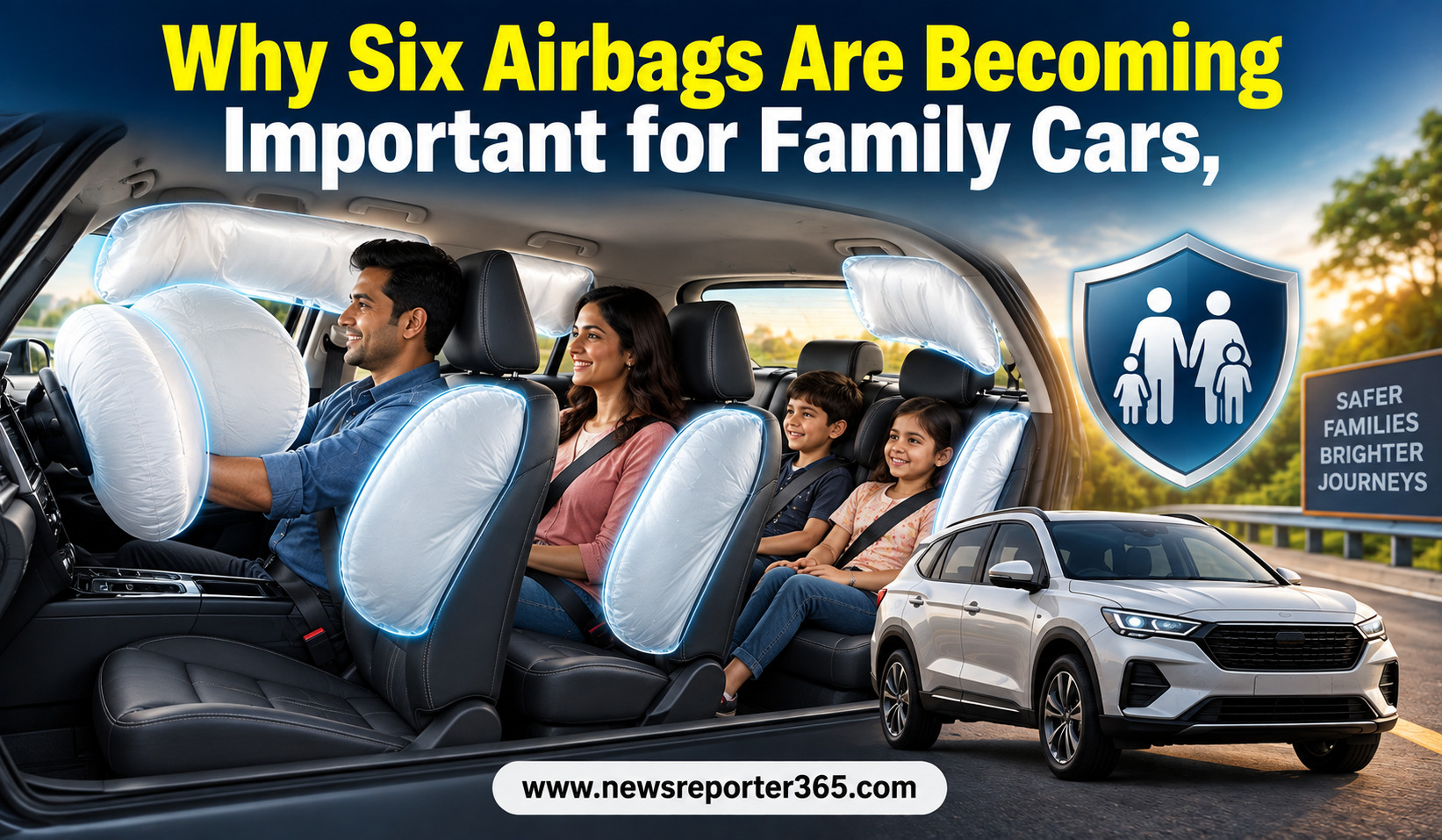
Safety has become one of the most important factors for Indian car buyers, especially families looking for a vehicle that can handle daily commuting, highway journeys and long-distance trips. Features such as ABS, electronic stability control, seat-belt reminders and advanced driver assistance systems are increasingly influencing buying decisions. Among these features, six airbags are becoming an important consideration for family cars.
Airbags are designed to provide an additional layer of protection during a crash. While they cannot prevent an accident, they can help reduce the risk of serious injury by cushioning occupants when a collision occurs. Having six airbags also means protection is not limited to the people sitting in the front seats.
The growing focus on six-airbag configurations reflects a broader change in how vehicle safety is being viewed. Buyers are increasingly looking beyond mileage, design and infotainment features and asking whether a car offers meaningful protection for everyone inside the cabin.
What Does a Six-Airbag System Mean?
A typical six-airbag setup includes two front airbags for the driver and front passenger, two side airbags and two curtain airbags. The exact configuration can vary depending on the vehicle and its safety system, but the basic purpose is to provide protection from different directions during a collision.
Front airbags are primarily designed to protect occupants during certain frontal impacts. Side airbags are intended to provide additional protection in side collisions, while curtain airbags generally deploy along the side windows to help protect occupants’ head areas.
This broader coverage is particularly relevant for family cars because these vehicles are frequently used with multiple passengers. Children, parents and other family members may occupy different seating positions, making all-round occupant protection an important consideration.
However, airbags should not be viewed as a replacement for seat belts. They are designed to work together with seat belts and other safety systems. Wearing a seat belt correctly remains one of the most important safety habits for every passenger.
Why Are Six Airbags Becoming More Important?
One major reason is the increasing awareness of passenger safety. Indian consumers are becoming more informed about crash-test performance and vehicle safety equipment. Safety ratings have become part of the car-buying conversation, and buyers are increasingly comparing safety features before making a purchase.
For family cars, this shift is particularly noticeable. A vehicle may be used for school runs during the week and highway travel on weekends. The occupants may include adults sitting in the front as well as children and other passengers in the rear. This makes protection across multiple seating positions more relevant.
Another factor is the changing expectations around standard safety equipment. Features that were once associated mainly with expensive vehicles are increasingly being offered on more affordable cars. Six airbags are an example of this trend, although availability still varies across models and variants.
The important point is that simply counting airbags should not be the only method of judging a car’s safety. A vehicle with six airbags still needs a strong body structure, effective seat belts and other safety technologies to provide comprehensive protection.
How Do Different Airbags Help?
Airbags are designed for different crash situations and occupant areas. Their effectiveness depends on the type of collision, the seating position, the vehicle’s design and whether occupants are properly restrained.
| Airbag Type | Main Purpose |
| Front airbags | Help protect the driver and front passenger in certain frontal crashes |
| Side airbags | Provide additional protection during some side impacts |
| Curtain airbags | Help protect the head area of occupants during certain side collisions |
Curtain airbags are particularly relevant for family vehicles because they can extend protection along the side of the cabin. Depending on the vehicle’s design, they may cover more than one seating row.
Nevertheless, airbag deployment is controlled by sensors and vehicle safety systems. Not every crash will cause every airbag to deploy, and deployment decisions depend on factors such as impact direction and severity.
Six Airbags and Rear Passenger Safety
For many years, discussions about car safety focused heavily on the driver and front passenger. Modern safety expectations increasingly consider rear-seat occupants as well.
Families often place children and elderly passengers in the rear seats. In the event of a serious side impact, additional protection around the sides of the cabin can become valuable. Curtain airbags are designed to help reduce the risk of certain head injuries during qualifying side impacts.
This does not mean the rear seat is automatically safe simply because a vehicle has six airbags. Seat-belt usage, correct seating position and the use of appropriate child-restraint systems remain essential.
Parents should pay particular attention to how children are secured. A child should not be treated as a small adult when it comes to vehicle safety. The correct child restraint, installation method and seating position can make a significant difference.
Six Airbags Are Only One Part of Vehicle Safety
A common mistake among buyers is assuming that a higher number of airbags automatically means a safer car. In reality, vehicle safety is made up of several connected systems.
A strong passenger compartment, effective crumple zones, seat belts, electronic stability control and braking systems all contribute to occupant protection. Modern vehicles may also include technologies such as ISOFIX mounts, traction control and various driver-assistance features.
When comparing family cars, buyers should therefore look at the overall safety package rather than focusing on one specification.
Some of the key areas worth checking include:
- Crash-test performance and the applicable test protocol
- Standard safety equipment across variants
- Electronic stability control and other active safety systems
- Seat-belt equipment and child-seat mounting options
A car with six airbags and weak performance in other important areas should not automatically be considered safer than every competitor.
Does Six Airbags Mean a Car Is Crash-Proof?
No. This is an important distinction. Airbags cannot prevent crashes and cannot guarantee that occupants will avoid injury.
Their role is to supplement other restraint and structural systems. During a collision, an airbag can help manage the forces experienced by an occupant, but its effectiveness depends on many factors.
Vehicle speed, collision angle, impact location, seat position and whether the passenger is wearing a seat belt can all influence the outcome. This is why manufacturers and safety organizations emphasize the combined use of airbags, seat belts and other protective technologies.
It is also important to understand that airbags are designed around specific crash conditions. They are not intended to protect against every possible type of accident.
Should Buyers Pay More for Six Airbags?
Whether paying extra for a six-airbag variant makes sense depends on the vehicle and the price difference. If the additional airbags are offered as part of a broader safety package at a reasonable premium, they can be a worthwhile feature for a family vehicle.
However, buyers should compare the complete equipment list. A more expensive variant may include several other features beyond airbags, while another model may offer similar safety equipment at a lower price.
The best approach is to compare vehicles based on safety ratings, standard equipment, structural performance and practical family requirements rather than choosing solely on the basis of airbag count.
What Family Car Buyers Should Check Before Buying
Before finalizing a family car, buyers should spend time understanding its safety specifications instead of relying only on advertising claims. The exact number and type of airbags should be checked for the specific variant being considered.
It is also worth checking whether important safety features are standard or available only on higher variants. Buyers should pay attention to the vehicle’s crash-test results and understand that ratings can differ depending on the testing organization and protocol.
A short safety checklist can include:
- Check the number and type of airbags on the exact variant.
- Look at the vehicle’s crash-test results and safety equipment.
- Check for electronic stability control and other essential safety systems.
- Make sure rear passengers have appropriate seat belts and child-seat provisions.
The Growing Safety Focus in Indian Cars
The Indian car market has changed significantly as safety awareness has increased. Buyers now discuss crash-test ratings, safety technology and occupant protection alongside traditional factors such as fuel efficiency and maintenance costs.
This trend is likely to continue as manufacturers compete to offer stronger safety packages across different price segments. Six airbags are therefore becoming less of a luxury feature and more of an expected safety consideration for many family-car buyers.
At the same time, consumers should avoid treating a single specification as proof of overall safety. A well-rounded safety package is more important than simply achieving a particular airbag count.
For families, the priority should be choosing a vehicle that offers strong occupant protection, dependable safety technology and suitable equipment for every passenger.
Conclusion
Six airbags are becoming important for family cars because they can provide broader protection to occupants during certain types of crashes, particularly when side and curtain airbags are included. As Indian buyers become more safety-conscious, features such as these are playing a larger role in vehicle purchasing decisions.
However, airbags work best as part of a complete safety system. Strong crash performance, seat belts, electronic stability control, child-seat compatibility and responsible driving remain equally important.
For families choosing a new car, six airbags can be a valuable feature, but they should be considered alongside the vehicle’s complete safety package. The safest buying decision is not simply about counting airbags—it is about understanding how all the safety systems work together to protect the people inside.
FAQs
Are six airbags enough to make a car safe?
No. Six airbags are an important safety feature, but overall vehicle safety also depends on structural strength, seat belts, electronic stability control, crash performance and other safety systems.
What are the six airbags in a car?
A common six-airbag arrangement includes two front airbags, two side airbags and two curtain airbags.
Are airbags useful for rear passengers?
Yes. Side and curtain airbags can provide additional protection for occupants in different seating positions during certain types of crashes. However, rear passengers must still wear seat belts.
Should children sit in a car with airbags?
Children can travel safely in vehicles equipped with airbags when appropriate seating and restraint practices are followed. Child seats should be used according to their instructions, and children should be positioned correctly.
Is a six-airbag car automatically safer than a four-airbag car?
Not necessarily. Airbag count is only one safety factor. Crash-test performance, body structure, seat-belt systems and electronic safety features also need to be considered.